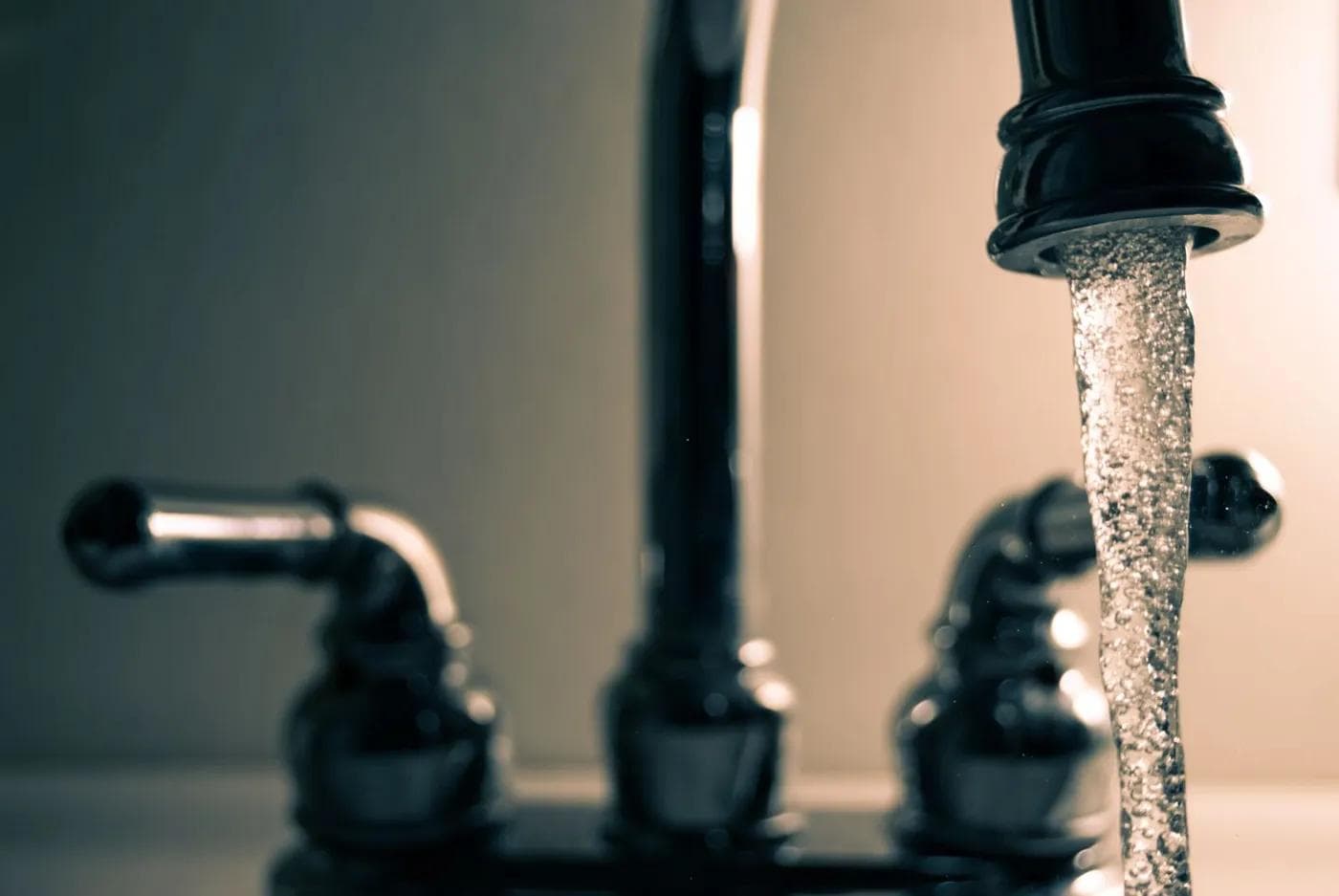
Most Murrieta homeowners know the water is hard because they can see it: white spots on glasses, crust around faucets, film on the shower glass. What they cannot see is the same mineral load settling inside the ice maker valve, the dishwasher spray arms, and the washing machine inlet screens. Those three components account for a large share of the water-related repair calls we take in Murrieta, and they fail in a predictable order.
This guide looks at what is actually in the local supply, how the damage progresses in each of those appliances, and how the three main treatment options compare once you put real repair costs against them. If you want a broader overview of hard water warning signs around the home, our earlier guide on how hard water in Murrieta affects your home appliances covers that ground. This post goes deeper on the local supply, the timeline, and the money.
Understanding Murrieta's water hardness
Murrieta is served by two water agencies. Rancho California Water District (RCWD) supplies a large part of the Murrieta and Temecula area, and Western Municipal Water District, which now operates as Western Water, runs a separate Murrieta water system. Which one supplies your home depends on your address, not your neighborhood name, so check your water bill if you are unsure.
The two agencies blend water differently. RCWD meets close to half of its demand from local groundwater and imports the rest from the Metropolitan Water District of Southern California, which draws on the Colorado River and Northern California, as described on RCWD's water quality page. Western Water publishes its own annual Consumer Confidence Report on its water quality page. The practical result for appliances is similar on both systems: hardness in the range of roughly 140 to 180 ppm.
In practical terms, 140 to 180 ppm is about 8 to 10.5 grains per gallon. On the classification used by the USGS and the water treatment industry, 120 to 180 mg/L is "hard" and anything above 180 is "very hard," so Murrieta water sits in the upper half of the hard band. Heat accelerates scale formation, but cold water lines still accumulate it steadily because they carry water every day for years.
For comparison, the best-known soft supply in California is San Francisco's Sierra snowmelt water, which typically runs under 60 ppm and falls in the soft range. Coastal Southern California cities that rely heavily on imported Colorado River water are not a soft-water baseline, so if you moved here from a Bay Area city, the difference in how quickly scale appears will be noticeable.
How hard water damages ice makers
The refrigerator ice maker is the most vulnerable appliance in a hard water home because it combines a long, narrow water line, a small solenoid valve that opens and closes many times a day, and a fill tube that sits next to freezing air. Damage moves along that path in order.
First, scale accumulates inside the water line and on the small screen at the inlet valve. Flow drops gradually, so the tray fills less with each cycle. Second, minerals build up on the valve's seat and diaphragm, the parts the solenoid moves to open and close the valve. The valve may stop opening fully, or stop closing fully, which lets water trickle into the fill tube where it freezes. Third, the module itself starts to suffer: an overfilled or frozen tray stresses the ejector mechanism, and the module eventually fails.
A typical progression on untreated water at 140 to 180 ppm looks like this. It is a common pattern, not a fixed schedule, and filter habits, usage, and the model all shift it.
- Years 1 to 3: Scale begins forming in the line and on the inlet screen. You may notice white specks in the ice or slightly smaller cubes, but production is mostly normal.
- Years 3 to 5: Restriction becomes noticeable. Cubes come out small or hollow and production slows. A water line cleaning ($95 to $150) often restores it completely.
- Years 5 to 8: The inlet valve becomes the likely failure point. Symptoms include a frozen fill tube, ice clumped together, or no fill at all. Valve replacement runs $150 to $220.
- Year 8 and beyond: The cascade stage. A restricted line, a sticking valve, and a module worn by repeated ice jams can all need attention at once, and a module replacement alone runs $180 to $320.
This is why our ice maker repair diagnosis always starts at the water line and works toward the module, not the other way round. Samsung refrigerators, which are common in Murrieta kitchens, follow the same pattern, and inlet valve corrosion is one of the faults we see most often during Samsung appliance repair calls.
Dishwasher spray arm scale build-up
A dishwasher cleans by forcing water through dozens of small holes in the spray arms. Hard water leaves mineral deposits on the edges of those holes on every cycle, and over two to three years without descaling, many of them narrow or close completely.
Visual diagnosis is straightforward. Turn the dishwasher off, remove the lower and upper spray arms (most twist or unclip, check your manual), and hold each one up to a light. Healthy arms show clear holes. Scaled arms show holes that are visibly narrowed, crusted with white deposits, or blocked. You may also find hard white residue on the filter and the inside of the door.
Cleaning performance degrades gradually, which is why owners often assume a pump or motor is failing. Blocked holes mean lower spray force and uneven coverage, so dishes on one side of the rack come out dirty while the rest are fine, and cloudy film builds on glassware. The pump is often fine. A professional scale cleaning costs $95 with the diagnostic waived, compared with $180 to $350 for a replacement spray arm assembly that does nothing about the water.
A monthly routine keeps this under control:
- Clean the filter at the bottom of the tub.
- Check the spray arm holes against a light and clear any blocked ones with a toothpick, never a metal pin.
- Keep the rinse aid dispenser topped up.
- Run an empty cycle with a citric acid dishwasher cleaner at least every three months, or monthly if white film keeps coming back.
If cleaning and descaling do not restore performance, our dishwasher repair service checks the pump, diverter, and controls.
Washing machine inlet valve clogging
Every washer has an inlet valve where the hot and cold hoses connect, with a small mesh screen at each inlet. The screens catch sediment and scale flakes before they reach the valve, and in Murrieta they gradually clog. The usual symptom is a washer that fills slowly, takes longer to complete a cycle, or reports a fill error.
Screen cleaning procedure:
- Unplug the washer and turn off both the hot and cold supply taps.
- Put a towel and a small bucket behind the machine, then disconnect both fill hoses at the washer.
- Check the screens in the hose ends and in the valve inlets on the back of the machine.
- Remove the valve screens gently with needle-nose pliers, rinse them under the tap, and soak crusted screens in a citric acid or white vinegar solution.
- Refit the screens, reconnect the hoses hand tight plus a quarter turn, turn the water on, and check for leaks before plugging the washer back in.
If a screen tears, replace it or the valve. Do not run the washer without it, because the debris it was catching will go straight into the valve.
Solenoid problems follow a recognizable pattern. Mineral staining often shows first on the hot water inlet. A valve that fills slowly on one temperature only is usually scaled on that side. A valve that lets water trickle into the drum while the washer is off has stopped closing properly and should be replaced promptly, since that is a flooding risk. Valve replacement runs $150 to $220 through our washer repair service.
As preventive maintenance, check the screens once a year, and at the same time inspect both fill hoses. Replace any hose that is bulging, cracked, or corroded at the fittings.
Three water treatment approaches ranked by cost and benefit
There is no single right answer here, and the math depends on how many water-using appliances you have and how long you plan to stay. These are the three options, from cheapest to most comprehensive.
Tier 1: Filter replacement and descaling cycles
Replace the refrigerator water filter every six months, run citric acid cycles in the dishwasher, and clean the washer screens annually. The cost is small and mostly consumables. This tier slows scale but does not stop it, because refrigerator filters reduce sediment and taste problems without removing hardness. Its payback is effectively immediate: a single $95 scale cleaning instead of a $180 to $350 spray arm replacement more than covers a year of consumables.
Tier 2: Under-sink RO filter for the refrigerator
A reverse osmosis system dedicated to the refrigerator line costs $500 to $900 installed, plus cartridge changes every 6 to 12 months. It protects only the refrigerator. The math: to pay back over 3 to 5 years, it needs to prevent roughly $100 to $300 of repairs per year. One ice maker cascade on a standard refrigerator (line cleaning, valve, and module together) costs about $425 to $690, and premium ice maker repairs cost more, so for a household that relies on its ice maker this tier often pays for itself within the typical 3 to 5 years.
Tier 3: Whole-house water softener
A whole-house softener costs $1,500 to $3,500 installed and protects every appliance, plus fixtures and plumbing. To pay back within 3 to 5 years, a $1,500 system needs to save about $300 to $500 a year, which is realistic in a home with a refrigerator ice maker, a dishwasher, and a washer all on hard water. A $3,500 system needs $700 or more a year to reach the same payback from appliance repairs alone, so at the top of the range, the softener is justified more by whole-home benefits than by appliance savings. Softeners also need ongoing salt and periodic service, and some California communities restrict salt-discharging units, so check local rules first. We do not install softeners, but we can show you what scale we are finding inside your appliances.
If your ice maker has slowed down, your dishwasher has stopped cleaning evenly, or your washer is taking longer to fill, call us on (951) 592-3670 or use the contact page. We work Monday to Saturday, 8 am to 5 pm, with same-day service for calls received before 11 am. The diagnostic is $89, waived if you go ahead with the repair, and you will have a flat-rate quote before any work starts.