Viking Professional ranges are a signature piece in many Greer Ranch and Copper Canyon kitchens. Some date from the original Greer Ranch builds; others went into newer Copper Canyon homes within the last decade. Either way, they are built for heavy use, and they reward a little consistent care. Most of the faults we repair on Viking ranges trace back to the same few things: grease where it should not be, burner parts that were not dried or reseated properly, and components left running hot for years without a check.
This guide covers the Viking Professional range maintenance a homeowner can do, what is better left to a technician, how the age of your range affects parts, and what an annual service visit includes. Before any cleaning or inspection, turn all burners and the oven off, let the range cool, and switch it off at the breaker. If you ever smell gas, stop, leave the house, and call SoCalGas (800-427-2200) from outside. Gas valves, regulators, and internal wiring are not homeowner jobs.
Grease management on Viking Professional ranges
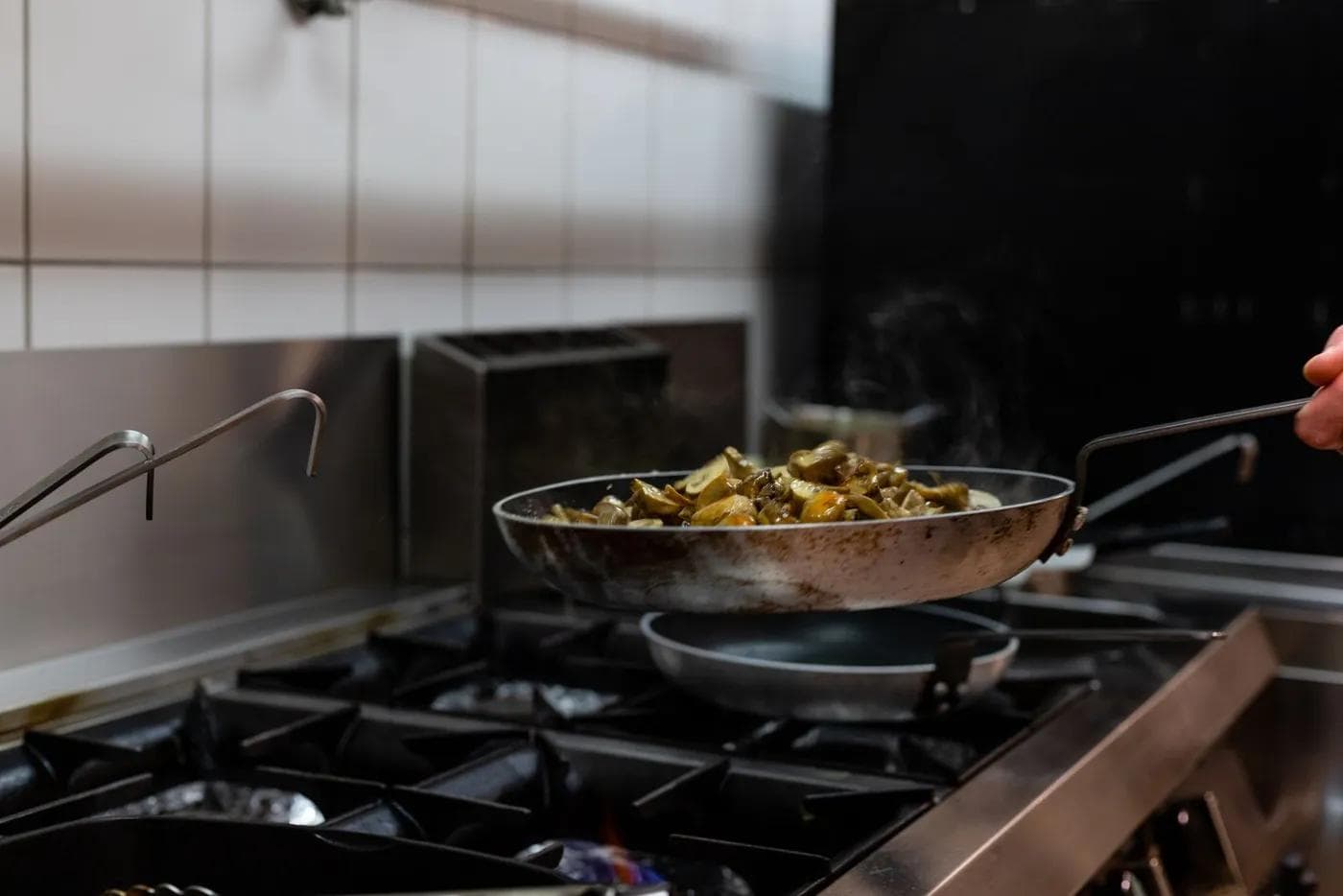
Grease is the single biggest maintenance issue on a professional-style range. These ranges are bought by people who cook a lot, at high heat, and high-heat cooking puts fine grease into the air that settles on every surface around and inside the range. Over years it builds up on burner bases, around igniters, under the cooktop, in the oven door, and on components behind the control panel, where it affects operation and adds heat stress to parts that are already working hard.
Most of the grease that matters can be managed with routine habits:
- Griddle drip pan. If your range has a griddle, Viking's own cleaning tips for ranges, rangetops, and ovens say the drip pan should be cleaned after each use, because the griddle burners sit directly above it and accumulated grease is a fire hazard. Pull it out, empty it, and wash it in hot soapy water.
- Hood filters. Your ventilation hood catches grease before it settles on the range and cabinets. Wash the filters regularly according to the hood manufacturer's instructions. A clogged filter moves less air and leaves more grease on the cooktop.
- Cooktop surfaces. Wipe the porcelain burner bowls and sealed burner surfaces with hot soapy water and a soft cloth after heavy cooking. For stubborn spots, use a non-abrasive blue scour pad, not steel wool.
- Control knobs. Pull the knobs off, wash them in hot soapy water, scrub gently without soaking, and dry them thoroughly before refitting.
- Stainless steel. Hot soapy water and a soft cloth, followed by a stainless polish, keeps the exterior clean without scratching.
What homeowners cannot reach is the grease that works its way under the cooktop and into the range body: around the burner valves, the wiring harness, and the spark module. That is where a periodic professional deep clean earns its keep. We remove the cooktop components, clear built-up grease from the areas around the gas and electrical parts, and check for heat-damaged insulation or connectors while we are there.
Do not spray cleaner directly onto the control panel or into the burner openings. Liquid running into switches and igniters is a frequent cause of clicking and ignition faults.
Burner cap and igniter tip maintenance
Viking Professional ranges use sealed burners with a separate cap and individual igniters. The cap's job is to spread the flame evenly; if it is dirty, chipped, or sitting off center, you get uneven flame, poor ignition, or a burner that will not light at all.
Clean the burner caps and grates with hot soapy water and a soft-bristle brush. For spots that remain, use a blue non-abrasive scour pad. The most important step is drying: Viking's guidance is to dry caps and grates thoroughly to prevent rust, then apply a very light coating of mineral oil to the underside once they are completely dry. Caps that go back onto the burner wet can also hold moisture against the igniter and cause clicking the next time you cook.
Check the burner ports for blockage. Food that has boiled over can bake into the small ports and choke part of the flame ring. A toothpick clears them without enlarging the openings; avoid metal pins or wire.
The igniter is the small ceramic post with a metal tip beside each burner. Grease on the tip stops the spark from reaching the gas. Brush it gently with a dry toothbrush. Do not use water or cleaner on the igniter, and do not bend or pry at it, because the ceramic cracks easily.
When you reassemble, seat each cap so it sits flat and centered on the burner head. A cap that rocks is one of the most common reasons a Viking burner clicks without lighting.
If a burner still clicks without lighting once everything is clean, dry, and seated, the igniter or the module behind it may be failing. Viking Professional ranges use individual burner igniter modules, and failures become common after about eight years. Replacement typically runs $220 to $400 per module.
Convection fan motor care
Viking Professional ranges with convection ovens use a fan at the back of the oven cavity to move heated air. Over time the fan motor's bearings wear, and prolonged high-temperature operation adds stress. There is no lubrication or adjustment a homeowner should attempt, but you can make the motor's life easier and catch problems early.
Keep the fan cover at the back of the oven clear. Do not block it with pans or foil, and follow your use and care manual on where foil and bakeware can go. Restricted airflow makes the fan and the oven work harder and causes uneven baking.
Wipe spills inside the oven once it has cooled rather than leaving them to bake on repeatedly. Grease and residue that build up around the fan cover end up being drawn toward the motor area.
Be thoughtful about self-cleaning on older ranges. A self-clean cycle runs the oven at extreme temperatures for hours, and on older ovens that heat is a common cause of failed thermal fuses, door lock motors, and control boards. On a range past about 12 years, manual cleaning is the safer choice.
Watch and listen for early warning signs:
- A grinding, squealing, or rattling noise from the back of the oven when convection is on
- The fan not spinning when convection mode is selected
- Uneven baking that was not there before
- A diagnostic code on newer models
Caught early, a failing convection motor is a straightforward replacement, typically $350 to $550 on a Viking oven. Left running until it seizes, it can take other components with it.
Pre-2013 vs post-2013 Viking parts considerations
Viking was founded in Greenwood, Mississippi, in 1987 and built its name on bringing commercial-style ranges into home kitchens. At the end of 2012, the Middleby Corporation, a commercial foodservice equipment manufacturer, agreed to buy Viking for $380 million in cash, and the acquisition is generally dated to 2013 (background on Viking Range). Viking remains based in Greenwood.
For homeowners, the practical point is that a Viking range's age affects how parts are sourced, not whether the range is worth looking after.
Pre-2013 Viking ranges. This group includes the mid-1990s to early-2000s Viking Professional ranges found in many original Greer Ranch builds. Parts availability for these ranges is generally good, but some legacy items are becoming harder to source. Where an original part is no longer stocked, there is sometimes an updated replacement part, and sometimes a specialist supplier still carries it. Older ranges from this era can also have specific wiring and terminal block issues that call for Viking-specific diagnostic knowledge.
Post-2013 Viking ranges. Newer Viking Professional installations, more common in Copper Canyon and newer builds, have standard parts availability through the manufacturer's distributor network. Standard components typically arrive in 3 to 5 business days, with less common items sometimes taking 5 to 10 business days.
We do not assume a part is available or unavailable based on age alone. The model and serial numbers, found on the metal identification tag inside the oven door frame, tell us which generation the range is. The diagnostic visit then confirms whether the specific part is available and from where, and we quote accordingly.
In both cases we use authorized Viking parts rather than aftermarket substitutes on Professional equipment. Aftermarket igniter modules in particular do not match Viking specifications reliably, and an ill-fitting part on a gas appliance is not where we want to save money.
Annual service checklist and what it costs
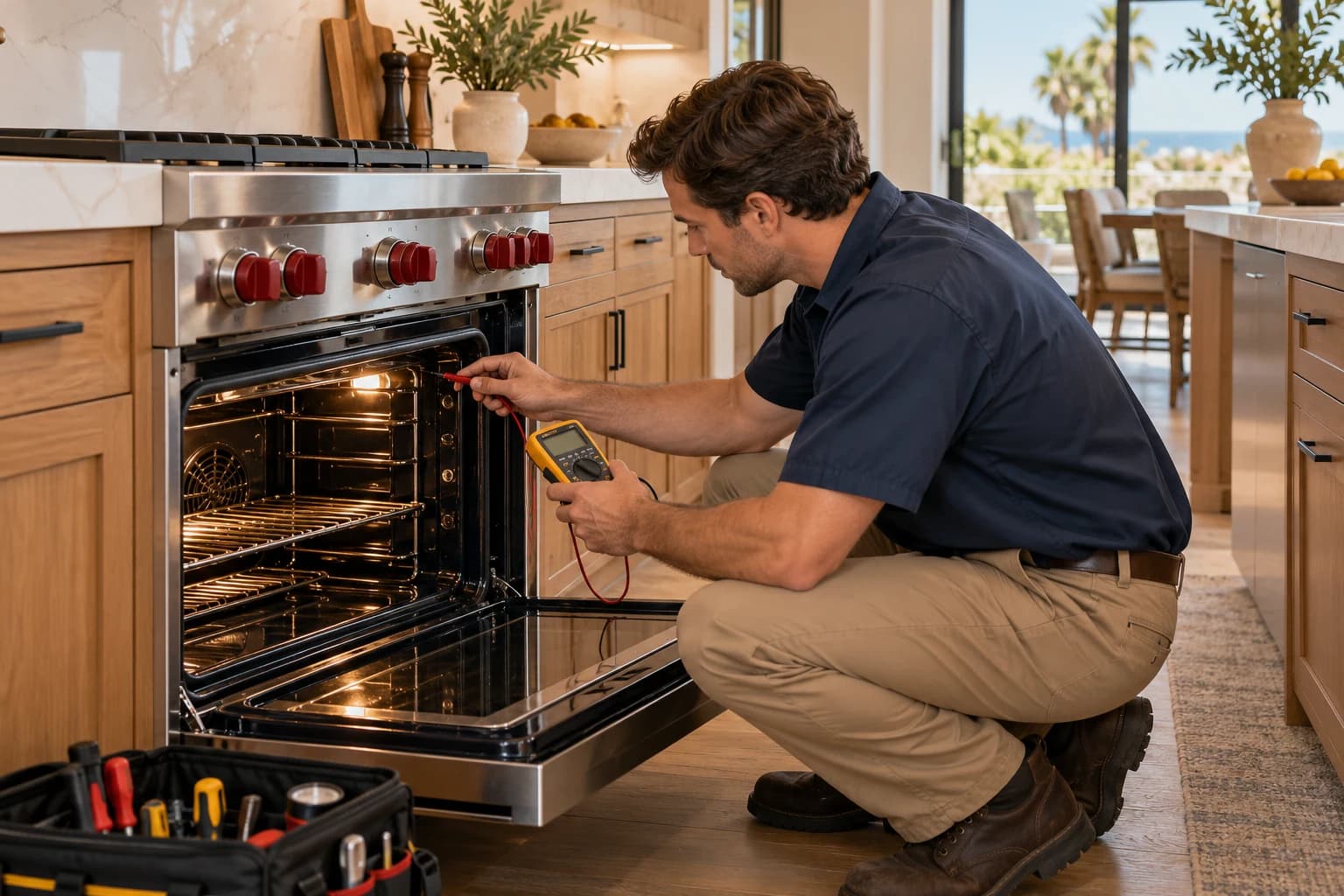
A once-a-year service visit is a sensible interval for a Viking range in regular use. Here is what our technician checks:
- Burners and ignition: spark at every igniter, flame quality and color at each burner, and cap and port condition
- Gas connections: a check of accessible connections for leaks, and burner performance that would point to a supply or pressure issue
- Grease build-up: inspection and cleaning around burner bases, under the cooktop, and near the valves, wiring, and spark module
- Oven performance: bake and broil operation, temperature accuracy, and the convection fan for noise and airflow
- Controls: knobs, switches, and the control panel for heat damage, moisture, or erratic behavior
- Door and seals: oven door gasket, hinges, and door closure
- Griddle or grill, if fitted: drip pan, drain tube, and burner condition
- Wiring: visible harness and terminal connections, especially on older ranges
Pricing works the same way as every call we take. The diagnostic is $89, waived if you proceed with any repair it identifies, and you receive a flat-rate quote before any work begins. If the visit finds a worn part, typical Viking repairs run $300 to $600 for standard components such as an igniter module or gas valve, while a convection fan motor typically runs $350 to $550 and a control board $400 to $800. Every repair carries a 90-day parts and labour warranty.
For context, replacing a Viking Professional range costs $5,000 to $12,000 depending on the model, so maintenance and repair make sense at any age under 15 years. Our Viking appliance repair page covers the full range of Viking equipment we service, and our oven and range repair page explains common oven faults across all brands.
To book an annual service or a repair, call (951) 592-3670 or use our contact page. We serve Greer Ranch, Copper Canyon, and the rest of Murrieta Monday to Saturday, 8 am to 5 pm, with same-day visits for calls received before 11 am. Mention that it is a Viking and have the model and serial numbers handy.