If your refrigerator stops cooling or your AC quits during a Murrieta heat spell, you need fast help. However, speed should not replace caution. A bad repair can waste money, damage your appliance, and leave you with no clear path to fix the problem.
This guide shows you how to find a trustworthy appliance repair company in Riverside County. You will learn what to ask, what to verify, what prices look like in 2026, and which red flags matter most for residential and commercial jobs.
Why “trustworthy” matters more in 2026
In 2026, the appliance repair market includes many legit local shops, but it also includes referral middlemen and fake listings. California consumer guidance warns you to protect yourself by verifying required licensing, getting warranties in writing, and keeping paperwork.
Scam risk is real because some operators collect deposits and then pass your job to unknown technicians. The California Department of Consumer Affairs also warns about referral companies that pose as repair services and resell leads to potentially unlicensed businesses.
If you live in Riverside County, climate also matters. Heat, dust, and long cooling seasons can increase wear on HVAC systems, refrigerators, garage freezers, and dryer venting. You can learn what local weather does to parts and performance in: How the California climate impacts your appliance lifespan.
Riverside County service landscape (Murrieta and nearby cities)
Riverside County covers a wide range of service areas. Murrieta, Temecula, Menifee, and Lake Elsinore often have faster scheduling because more providers work those routes. More remote areas can see longer wait times, so you should confirm service radius and trip fees before you book.
You should also confirm the company name that will show up at your door. DCA warns that a red flag appears when a different company contacts you after you requested service from the original brand.
The 5 biggest scam patterns in appliance repair (and how to spot them)
Scam pattern 1: Referral companies that take your deposit first
DCA warns consumers to be wary of referral companies that take leads and deposits and then resell your contact information to other companies.
What you do: Ask, “Are you the company that performs the repair, or do you subcontract the job?” Then ask for the exact business name of the technician’s employer.
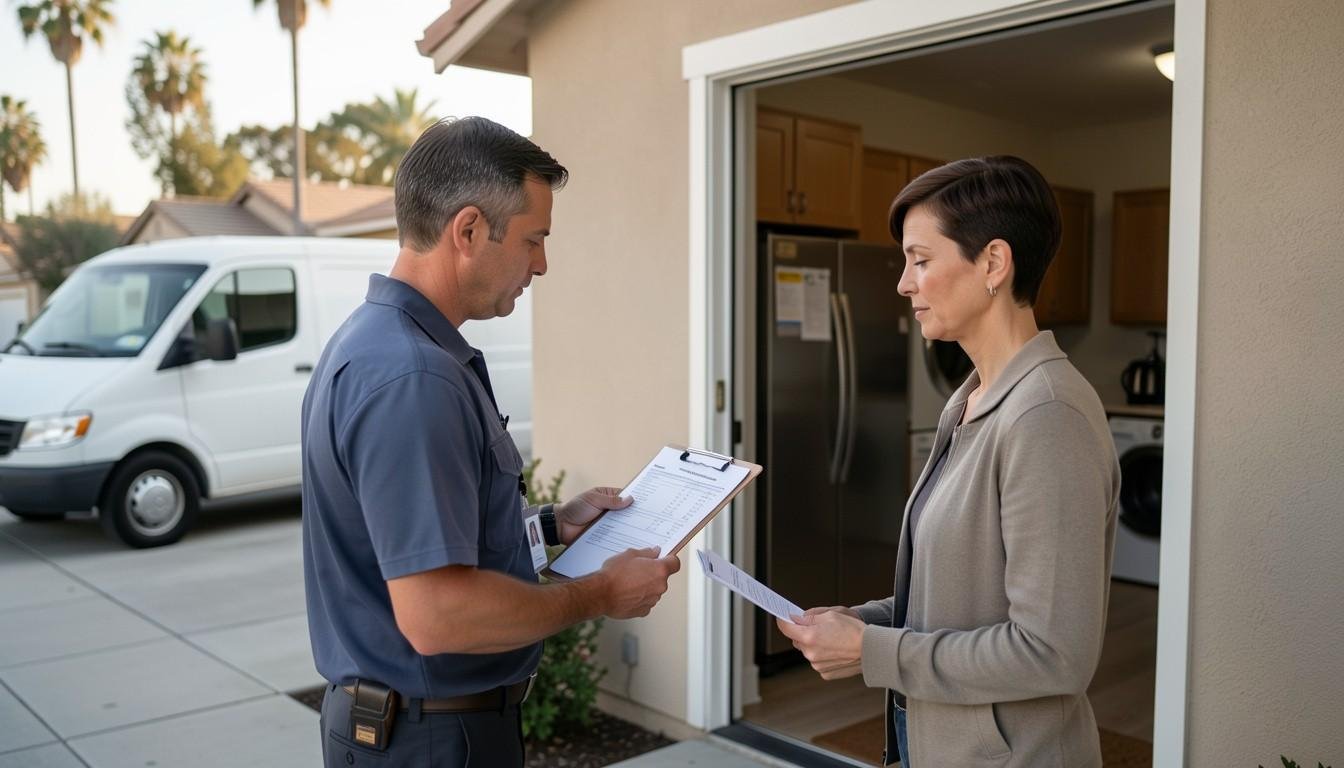
Scam pattern 2: A technician shows up in an unmarked vehicle with no ID
DCA flags unclear identity and different company names as warning signs.
What you do: Ask for a company ID and a written work order that shows the company name and registration details.
Scam pattern 3: Big deposit demands before diagnosis
DCA lists overly large deposits as a red flag.
What you do: Expect a diagnostic fee in many cases. Avoid large deposits for parts before you see a written estimate.
Scam pattern 4: Vague invoices with no parts or labor detail
DCA warns about unclear invoicing and missing parts and labor breakdowns.
What you do: Require itemization. You should see part name, part status (OEM or aftermarket), and labor line items.
Scam pattern 5: The company takes your old parts without offering them
DCA includes “parts taken out are not identified and accounted for” as a red flag, and Riverside County DA guidance also advises you to keep replaced mechanical parts for home repairs.
What you do: Ask the tech to leave replaced parts with you, unless warranty return rules require otherwise.
Licensing and legal basics in California: BHGS registration vs contractor licensing
Appliance repair registration (state-level consumer protection)
In California, appliance repair may fall under state registration through the Bureau of Household Goods and Services, which covers “Electronic and Appliance Repair.”
DCA specifically tells consumers to verify the company has the required state license or registration before hiring.
HVAC repair licensing (when it crosses into contractor work)
If you are hiring for HVAC repair or installation, licensing rules can be different. CSLB defines the C-20 classification for warm-air heating, ventilating, and air-conditioning contractors.
For commercial customers, you should treat licensing and insurance as non-negotiable. You protect your building, your tenants, and your liability exposure when you verify credentials.
If you are comparing HVAC options because repairs keep stacking up, use: Choosing the right HVAC system for Murrieta’s microclimate so you do not overspend on the wrong size or setup.
The “$500 rule” and why your quote structure matters
Many California licensing discussions reference a $500 threshold for contractor work (labor and materials). Some HVAC licensing resources state that HVAC work over $500 requires a CSLB contractor license.
Because rules and thresholds can vary by work type and how the job is structured, you should ask for a written estimate that clearly shows labor, parts, and total job cost.
What a professional estimate should include (so you can compare apples to apples)
A trustworthy appliance repair company gives you a clear estimate that you can read in one pass.
You should see:
- Appliance brand, model number, and symptom summary.
- Diagnostic results and likely root cause.
- Parts list with part numbers when possible.
- Parts type: OEM, aftermarket, or refurbished.
- Labor scope and labor rate or flat-rate line item.
- Trip fee and diagnostic fee rules, plus whether they credit it toward repair.
- Warranty terms in writing.
DCA also recommends you get written copies of guarantees and warranties.
Deposits, diagnostic fees, and payment terms (normal vs red flags)
Diagnostic fees are common. HomeGuide reports a service call cost of $70 to $130 on average, and it notes that the fee often includes travel, diagnostics, and the first hour of labor.
What looks normal:
- A clear diagnostic fee with a written range.
- A written estimate after diagnosis.
- Payment after completion, or a reasonable parts deposit for special-order items.
What looks risky:
- Large deposits demanded before anyone inspects the appliance.
- Pressure to pay by wire transfer or unusual methods.
- No paper trail.
Proof you should ask for before booking (quick verification checklist)
Ask for these items before you commit:
- License or registration number (and how you can verify it).
- Proof of insurance (especially for commercial jobs).
- Written warranty policy.
- Business address and service area.
- A clear cancellation and reschedule policy.
DCA’s self-help guidance also reminds you to save paperwork such as receipts, contracts, and warranty documents.
Reviews and reputation: how to read Google and Yelp like a pro
You should read reviews like an investigator, not like a casual shopper.
Look for:
- Recency: do they have recent reviews from Riverside County customers?
- Specificity: do reviews mention appliance types, brand names, and outcomes?
- Patterns: do multiple reviews mention deposit, different company, or no itemized invoice?
Also watch for a mismatch between brand name and who arrives. DCA flags this kind of identity confusion as a red flag.
Technician quality signals (what pros do differently)
A trustworthy tech:
- Confirms model and serial number before quoting parts.
- Explains what failed and why.
- Tests the appliance after repair.
- Documents readings when relevant (temps, amp draw, gas ignition behavior).
- Leaves a clean work area.
For gas appliances, safety habits matter. For refrigeration sealed-system issues, training and tools matter. You can still ask about experience without turning the call into an interview. Keep it simple and direct.
Parts strategy in 2026: OEM vs aftermarket vs refurbished
Parts choice affects cost, reliability, and warranty.
Ask these questions:
- “Will you use OEM parts or aftermarket parts?”
- “If you use aftermarket, what warranty comes with the part and with your labor?”
- “Will you show me the part packaging or part number on the invoice?”
DCA warns that unclear work orders and unclear part documentation are red flags, so you want part transparency.
Repair vs replace math (with real cost ranges)
You can make a smarter decision when you know typical cost ranges.
HomeAdvisor lists typical appliance repair costs with examples such as:
- Refrigerator: $200 to $300.
- Dishwasher: $160 to $300.
- Washing machine: $50 to $450.
- Dryer: $100 to $400.
HomeGuide reports broader ranges and also notes a $70 to $130 service call cost, and it highlights that compressor replacement can cost $700 to $1,250 due to sealed-system labor and refrigerant work.
Use a simple rule:
- If the repair restores safe, reliable operation and the cost stays well below replacement, repair often wins.
- If the repair requires a major sealed-system job on an old unit, replacement may be smarter.
If you suspect your appliance or HVAC is driving up your power bill, you can also read: How to lower your utility bills during a California heatwave to spot the efficiency red flags before you pay for repeat service calls.
Appliance-by-appliance trust check questions (use these on the phone)
Use these questions to filter companies fast.
Washer and dryer:
- “Do you test drain, spin, and heat performance before you leave?”
- “Do you check dryer vent airflow if cycles run long?”
Refrigerator and freezer:
- “Will you confirm actual compartment temps before and after repair?”
- “If you suspect sealed-system issues, do you handle that in-house or refer out?”
Dishwasher:
- “Will you check for leaks during a full cycle or a fill and drain test?”
Microwave:
- “Do you test door switches and confirm safe operation after repair?”
Gas oven and range:
- “Do you test ignition, flame quality, and safety operation after the repair?”
If the company avoids direct answers, move on.
Commercial customers: how to vet for restaurants, offices, and property managers
Commercial jobs require process, documentation, and fast communication.
You should require:
- Insurance proof and W-9 if your accounting team needs it.
- Clear scheduling windows and a written SLA for urgent calls if you manage many sites.
- Itemized invoices that match your PO process.
- Warranty terms that are easy to enforce.
You should also ask how they handle repeat calls. A trustworthy company tracks the model, the repair history, and the parts used.
What works and what doesn’t when choosing a repair company
What works:
- You verify registration or licensing before booking. DCA recommends verifying required license or registration.
- You require a written estimate and written warranty. DCA advises you to get warranties and guarantees in writing.
- You keep paperwork and document the job. DCA advises you to save paperwork and keep copies of correspondence.
What does not work:
- You choose only by the lowest price and ignore red flags.
- You accept vague invoices with no parts and labor detail.
- You pay large deposits before diagnosis.
If you want a quick “self-audit” to reduce repeat breakdowns, link readers to: Top 5 energy-wasting habits in Murrieta homes, because many repeat calls start with airflow, overloading, or maintenance gaps.
Paperwork that protects you: work orders, invoices, and replaced parts
Paperwork protects you if something goes wrong.
Keep:
- Work order and invoice.
- Warranty terms.
- Photos of the model and serial number tag.
- Notes on the symptom and what the tech replaced.
Riverside County DA guidance also advises you to get written itemizations and to keep replaced mechanical parts for home repairs over $200.
If a repair goes wrong: escalation steps that work
If you have a problem, act fast and stay organized.
- Contact the company in writing and state the issue clearly. DCA notes that a letter to the manager is often effective and that you should keep copies.
- Ask for a return visit and a written resolution plan.
- Keep all receipts and warranty documents.
- If the company will not resolve the issue, consider filing complaints through the DCA and other listed resources.
Riverside County consumer protection resources and fraud reporting basics
Riverside County’s District Attorney Consumer Fraud Unit investigates unfair or dishonest business practices and encourages consumers to be on guard and follow smart buying behavior.
If you suspect fraud, keep your documents and timelines. Your documentation is your leverage.
Your “Trustworthy Company” checklist (copy and use)
Use this checklist before you book:
- The company clearly states its legal business name.
- The company provides license or registration details you can verify.
- The company provides a written estimate and a written warranty.
- The company itemizes parts and labor and explains part type.
- The company has a clear diagnostic fee policy.
- The company does not pressure you for a large deposit.
- The tech shows ID and arrives under the same company name you booked.
- The company gives you invoices and keeps communication in writing.
When you should stop troubleshooting and schedule service (safety triggers)
Stop DIY troubleshooting and schedule service if:
- You smell gas near a range or oven.
- A breaker trips repeatedly when the appliance runs.
- You see burning smells, sparking, or melting plastic.
- Your refrigerator stops cooling and food safety is at risk.
- Your HVAC system blows warm air during extreme heat and indoor temps rise quickly.
Safety comes first. Property damage comes second. Savings come third.
If you want a local team that handles home appliance repair and HVAC repair in Murrieta and nearby Riverside County cities, you can reach: Appliance Repair Murrieta for a clear diagnostic process and a written estimate.
If you want to schedule service or ask a quick question first, use: Contact Appliance Repair Murrieta.