People talk about the “Sunshine Tax.” We pay more for gas, housing, and groceries to live in this beautiful state. But few homeowners realize there is also a hidden “Appliance Tax.“
If you moved here from the Midwest or the East Coast, you might expect your water heater to last 15 years or your air conditioner to run for 20. In California, those numbers are often fantasies.
Our unique environment aggressively attacks machinery. We have a corrosive marine layer that travels miles inland. We have blistering desert heat that pushes compressors to the breaking point. We have mineral-heavy hard water that turns plumbing into stone. And now, we have year-round wildfire ash that acts like acidic glue on sensitive coils.
It is not just bad luck when your refrigerator dies in seven years. It is physics.
This guide explains exactly how the California climate shortens the life of your expensive equipment. More importantly, it gives you the specific, actionable steps you need to fight back and protect your investment.
The Coastal Effect: Salt Air Corrosion (Even Miles Inland)
You might look out your window in Murrieta and see hills, not the ocean. You assume you are safe from salt air. You would be wrong.
The marine layer is a powerful force. That morning fog you see rolling through the valley carries microscopic salt aerosols. It travels up to 10 miles inland. When the sun burns off the fog, the water evaporates, but the salt stays behind.
The Invisible Chemistry of Rust
This salt settles on your outdoor appliances. It lands on the condenser coils of your AC unit. It coats the stainless steel of your outdoor grill.
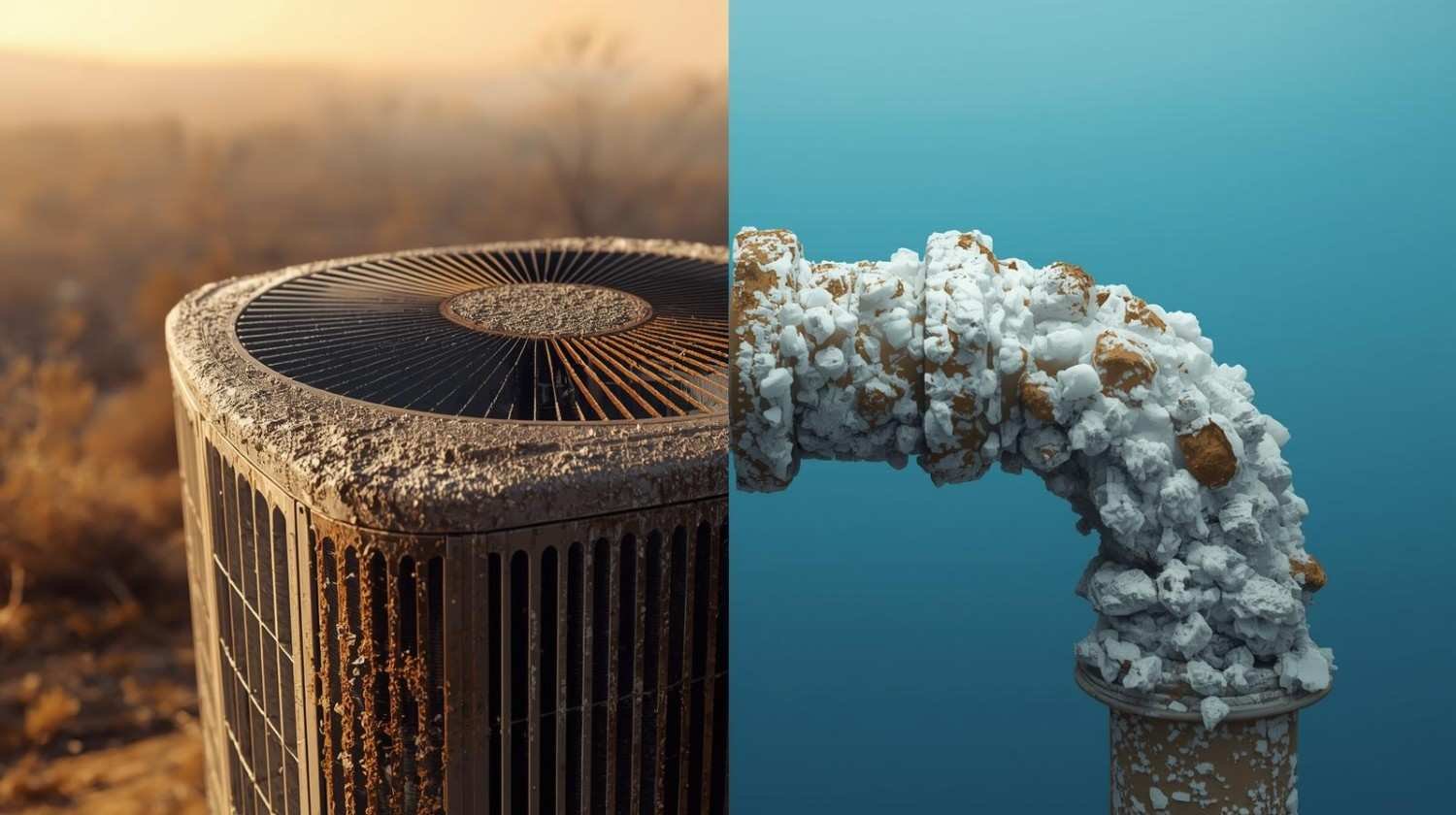
Salt initiates “galvanic corrosion.” It eats the aluminum fins on your air conditioner. Over time, these fins turn brittle and crumble into white dust. We see units that are only five years old with fins that disintegrate when you touch them.
When the fins degrade, the unit cannot release heat. The compressor has to work twice as hard to cool your home. Efficiency drops by 40%. The electric bill spikes. Then, the compressor burns out.
Protecting Electronics
The danger is not just to metal. Salt humidity is conductive. It creeps into the control boards of washing machines located in garages or laundry rooms near open windows. It corrodes the tiny copper traces on the circuit board, causing “ghost” errors and total system failure.
The Heat Factor: How Inland Summers Kill Compressors
Let’s talk about the heat. In the Inland Empire, summer temperatures regularly hit triple digits. This thermal stress is the number one killer of refrigeration equipment.
The Garage Fridge Trap
Many Californians have a second refrigerator in the garage for drinks and overflow food. In July, your garage can easily reach 105°F or 110°F.
Refrigerators work by moving heat. They pull heat out of the food compartment and dump it into the room. When the room is 110°F, the fridge struggles to dump that heat.
The compressor runs 100% of the time. It never cycles off. The oil inside the compressor breaks down due to the constant high temperature. A fridge that would last 14 years in a climate-controlled kitchen often dies in 6 years in a Murrieta garage.
HVAC Capacitors: The Weak Link
Your air conditioner uses a component called a capacitor. Think of it as a battery that gives the motor a jolt to start running.
Capacitors hate heat. Extreme temperatures cause the fluid inside them to expand. The metal casing swells like a balloon. Eventually, it bursts or loses its ability to hold a charge.
When the capacitor gets weak, the motor tries to start but can’t. It hums loudly, overheats, and shuts down. If you catch it early, it is a cheap repair. If you ignore the humming, you burn up the motor.
Wildfire Season: The New “Ash Clog” Threat
Wildfire season used to be a few weeks in the fall. Now, it feels like a year-round threat. Smoke is not just a breathing hazard; it is an appliance killer.
The Acidic Sludge
Smoke contains ash, which is Particulate Matter 2.5 (PM2.5). This ash is chemically acidic.
During a fire, ash falls like snow. It gets sucked into your AC unit. It lands on the outdoor coils. At night, the dew point rises, and moisture settles on the coils. This moisture mixes with the ash to form a corrosive, sticky sludge.
This sludge does two things. First, it eats the metal. Second, it blocks the airflow. It acts like a wool blanket wrapped around your air conditioner.
The Filter Crisis
Inside your home, your HVAC filter catches the smoke particles. During a fire event, a filter that usually lasts three months can clog in three days.
A clogged filter chokes the system. The blower motor has to push against a brick wall of air. The motor overheats and fails. We see a spike in blower motor replacements every single time there is a major local fire.
The Silent Destroyer: Hard Water & Drought
Water quality is the silent assassin of California appliances. Our water is hard. It is full of dissolved calcium and magnesium.
The Numbers Don’t Lie
The average water hardness in our area is often 15 grains per gallon or higher. That is considered “extremely hard.”
Studies show that operating a water heater on hard water cuts its efficiency by 48% over 15 years. But in California, they rarely last 15 years. The average life expectancy of a tank water heater here is closer to 6 to 8 years without maintenance.
Why It Happens
The minerals solidify when heated. They form a rock-like layer of scale at the bottom of the tank. This scale acts as an insulator. The burner has to heat the rock before it heats the water. This overheats the metal tank bottom, causing it to crack and leak.
Dishwashers and Tankless Units
Hard water is even worse for modern appliances. It clogs the tiny spray arm jets in your dishwasher. It creates scale in the narrow heat exchanger tubes of tankless water heaters. This triggers error codes and shuts the system down to prevent melting.
During drought years, the problem gets worse. As reservoir levels drop, the concentration of minerals in the water supply increases. The water gets harder, and the damage accelerates.
2026 Decarbonization Rules: What It Means for Replacements
California is aggressively moving toward “Zero Emission” appliances. The state wants to phase out gas appliances in favor of electric heat pumps.
The Shift to Heat Pumps
If your old gas furnace dies in 2026, you might be encouraged—or in some new construction scenarios, required—to install a heat pump.
A heat pump is an air conditioner that can run in reverse. It cools in the summer and heats in the winter.
The Wear and Tear Factor
Think about what this means for lifespan. A gas furnace sits idle for 8 months of the year. A heat pump runs 12 months of the year. It never gets a vacation.
Because they run year-round, heat pumps accumulate wear and tear twice as fast as standalone AC units. They require more diligent maintenance. If you skip the biannual checkup, you will be replacing the system much sooner than you expect.
Strategic Maintenance: A Climate-Resilient Checklist
You cannot change the weather. But you can change how you maintain your home. Standard advice from national magazines does not apply here. You need a California-specific battle plan.
1. The Coastal Rinse (Monthly)
If you live within 10 miles of the ocean, you must wash your outdoor AC unit.
- Do: Use a garden hose with a gentle spray nozzle. Rinse the coils from top to bottom to wash away salt residue.
- Do Not: Use a pressure washer. It will bend the fins and destroy the unit instantly.
2. The Garage Fridge Audit
If you have a fridge in the garage:
- Vacuum the Coils: Do this every 6 months. Dust acts as an insulator. If the coils are dirty and the garage is hot, the compressor has no chance.
- Check the Seals: Make sure the door gaskets are tight. If cold air leaks out, the compressor works even harder.
3. The Smoke Protocol
After any major wildfire event in the region:
- Change the Filter: Throw away your indoor HVAC filter immediately, even if it looks okay. The microscopic ash particles are deep inside the fibers.
- Wash the Unit: Rinse the outdoor unit to remove the acidic ash before the next morning’s dew sets it into sludge.
4. The Hard Water Defense
You have two choices: treat the water or flush the tank.
- Install a Softener: A whole-home water softener is the only way to stop scale permanently. It will double the life of your dishwasher and water heater.
- Flush the Tank: If you don’t have a softener, you must flush your water heater once a year. Connect a hose to the bottom valve and drain the sediment. If you hear “popping” noises from the tank, you are already overdue.
5. The Hard Start Kit
Consider installing a “Hard Start Kit” on your AC unit. This device stores extra energy to help the compressor start during high-heat days. It reduces the strain on the motor by up to 50% during startup. It is a small upgrade that adds years to the system’s life.
Living in California is wonderful, but it is hard on our homes. The sun, the salt, and the soil all work against your appliances.
You don’t have to let the climate win. With the right maintenance strategy, you can get full life out of your machines.
If you are worried about the condition of your AC coils, or if your water heater is making strange noises, let us take a look. At Appliance Repair Murrieta, we understand the local environment. We know how to harden your home against the elements. Schedule your inspection today and stop the silent damage before it gets expensive.