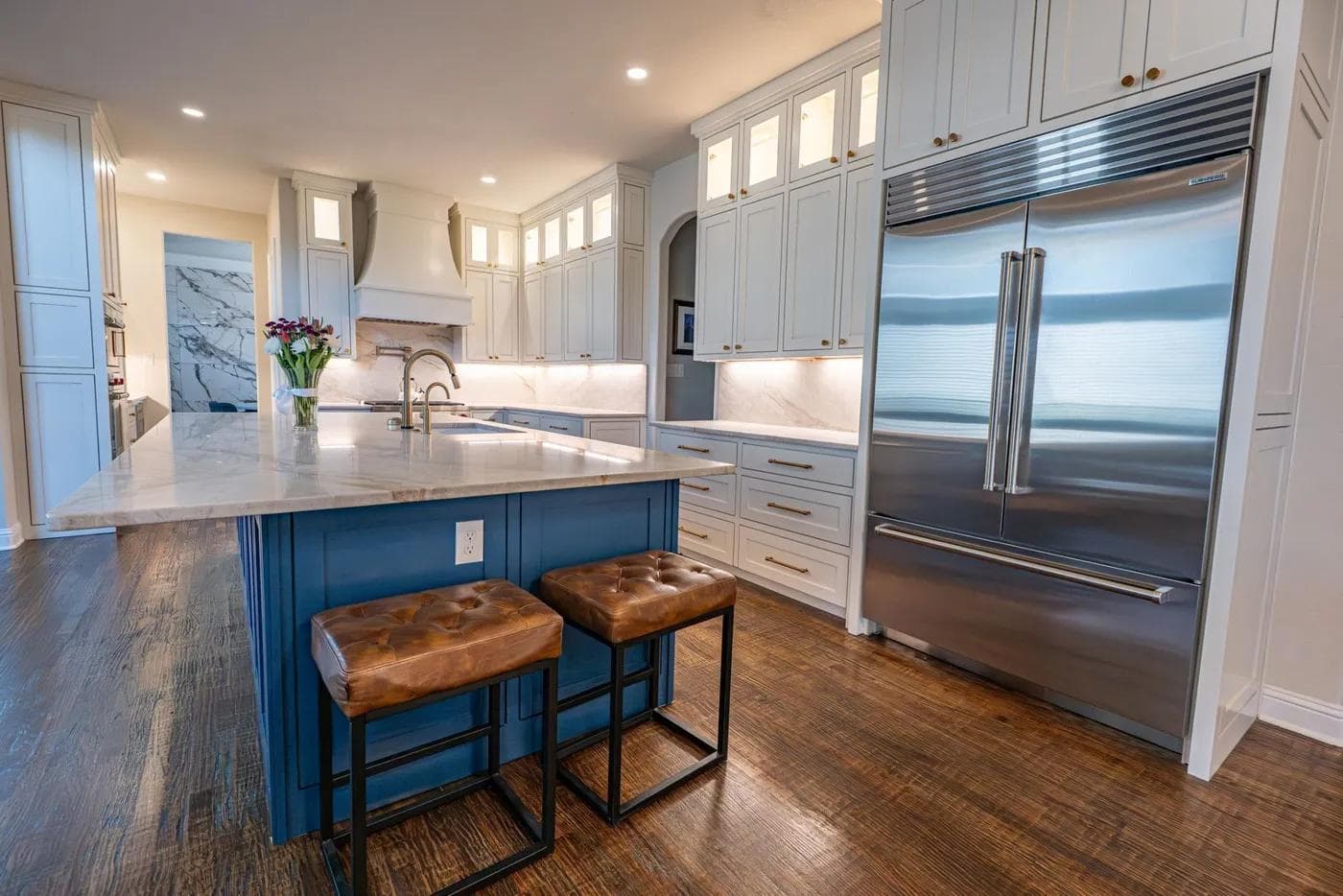
A Sub-Zero built-in column is one of the most expensive appliances in a Greer Ranch kitchen, and one of the most forgiving if it is looked after. Most of the Sub-Zero failures we see in Murrieta are not random. They trace back to a dusty condenser, a cabinet that does not let the unit breathe, a door seal that has stopped sealing, or hard water working its way through the ice maker. All four are predictable, and most of them are cheap to deal with early.
This guide covers what a Greer Ranch homeowner can check themselves, how often to do it, and where the work should be handed to a technician. Before any check that involves removing a grille or touching the water supply, switch the unit off at its control panel, and if you are cleaning around the machinery compartment, disconnect power at the breaker as well.
Why Sub-Zero maintenance matters for Greer Ranch kitchens
Sub-Zero refrigeration is built for a service life of 20 years or more, but that figure assumes the unit has been maintained. A built-in column runs its compressor in a confined cabinet space, and anything that makes it work harder, such as a coated condenser, a restricted air path, or warm air leaking past a tired gasket, shortens the life of the most expensive parts in the system.
The financial case is simple. A replacement Sub-Zero built-in unit costs $8,000 to $16,000 depending on the model, before any cabinetry adjustments. Annual maintenance costs a small fraction of that. Even a sealed system repair, which is the most expensive category of Sub-Zero work, usually comes in well under a third of replacement cost.
Timing matters in Greer Ranch specifically. Many homes in the community date from the mid-2000s original build era, and the BI-36, BI-42, and BI-48 columns installed then are now roughly 15 to 20 years old. That is the age when original gaskets harden, condenser fan motors start to wear, and ice maker valves that have spent their whole life on hard water begin to fail. It is also well past the factory warranty. Sub-Zero's residential warranty covers parts and labour for 2 years, the sealed system for 5 years, and sealed system parts for 12 years, so a unit from the original build era is now carrying its own risk. Regular maintenance is how you keep that risk small.
Annual coil cleaning: the single most important maintenance task
The condenser is where your Sub-Zero gets rid of the heat it pulls out of the food compartments. When the condenser fins are coated in dust and lint, heat cannot escape efficiently, the compressor runs longer cycles to hold temperature, and both the compressor and the condenser fan motor wear faster. Sub-Zero's own guidance is to clean the condenser every six to twelve months, and more often if pets are in the home, and it warns that failing to do so can lead to temperature loss or mechanical failure.
Murrieta conditions push you toward the shorter end of that range. Our summers regularly bring long stretches of high afternoon heat, so the condenser is already working hard, and the dry climate and seasonal Santa Ana winds carry fine dust that settles on condenser fins faster than in a coastal kitchen. In practice, every six months is a sensible target, and once a year should be treated as the minimum, not the goal.
On BI-36, BI-42, and BI-48 columns, the condenser sits behind a grille in the machinery compartment. The grille position and how it opens depend on the model and its production generation, so check the Use and Care Guide for your specific model before you start. The general procedure is:
- Switch the unit off at the control panel, and disconnect power at the breaker if you will be working close to the fan or wiring.
- Open or remove the grille as your model's guide describes.
- Vacuum the condenser fins with a soft brush attachment, working in the direction of the fins.
- Do not bend the aluminum fins, and do not use condenser cleaning chemicals or degreasers. Sub-Zero does not recommend them.
- Refit the grille and restore power.
A vacuum with a soft brush should be your first tool, because it removes dust rather than moving it around. Compressed air, either from a can or a compressor on a low setting, is useful for dust packed deeper into the fins that the brush cannot reach. Use it after vacuuming, not instead of it, and expect to vacuum again afterwards because the air will push some of the dust into the compartment.
If you are comfortable with the steps above, DIY cleaning costs nothing but time. If the grille is awkward to reach, the fins are heavily packed, or you would rather have someone look at the fan and compressor while the compartment is open, a technician coil cleaning runs $95 to $150.
Ventilation clearance inspection
A built-in Sub-Zero draws cooling air in through its grille and needs a clear path to move warm air away from the condenser. If that path is restricted, the unit behaves as though its condenser is permanently dirty, even right after a cleaning.
This is a known issue in some older Greer Ranch builds. Original cabinet designs sometimes left less clearance than Sub-Zero's installation requirements call for, and later remodels can make it worse: decorative trim added over the grille, a panel or valance that partly covers the opening, or items stored on top of or directly in front of the unit.
You can do a basic check yourself. Confirm that nothing covers any part of the grille, including trim, toe-kick panels, or rugs at floor level. Measure the open grille area and the space around the unit, then compare those dimensions with the installation guide for your exact model number, which is printed on the serial tag inside the unit. If anything has been added to the cabinetry since the original install, look at it closely.
Diagnostically, a ventilation restriction tends to show up as a compressor that runs almost continuously on hot afternoons, temperatures that drift upward later in the day and recover overnight, a grille area that feels noticeably warm, and condenser fan noise that has increased over time. The same symptoms can come from a failing condenser fan motor or a sealed system problem, which is why we measure rather than guess.
Call for a professional assessment if the unit struggles to hold temperature after a thorough condenser cleaning, if you have changed the cabinetry around it, or if you hear the compressor running far longer than it used to. Our diagnostic establishes whether the fault is in the appliance or in the installation, which matters because replacing a compressor in a cabinet that still cannot breathe only resets the clock.
Door gasket inspection and replacement timing
Sub-Zero doors are heavy and the gaskets are designed to seal to specific tolerances. When a gasket stops sealing, warm humid air leaks in, the unit runs longer, and you may see condensation or frost forming near the door edge.
The dollar bill test is the simplest check. Close the door on a dollar bill so that half of it is inside the cabinet, then pull it out. A good seal gives firm, even resistance. Repeat the test at the top, bottom, and both sides of each door, including the corners. If the bill slides out easily at any point, that section is not sealing properly. Also look for gaskets that have flattened, hardened, cracked, or torn, especially at the hinge-side corners, which take the most flexing.
On Sub-Zero units around 8 years old and older, the common pattern we see is gradual hardening and compression rather than a sudden tear. The gasket still looks intact, but it no longer springs back against the frame, and the leak develops slowly enough that most owners do not notice until they see condensation or a rising electric bill.
Authorized Sub-Zero gaskets typically cost $180 to $350 depending on the door size and model. We do not fit aftermarket gaskets on Sub-Zero equipment. Generic gaskets are not made to the same specification for magnet strength, profile, and material, so they often fail to seal evenly against a Sub-Zero door frame, and you end up paying for the repair twice. Clean gaskets with warm water and mild soap a few times a year and dry them, which helps them stay flexible longer.
Water filter replacement and ice maker protection
Replace the refrigerator water filter every six months. The filter reduces sediment and improves taste, and an overdue filter lets more debris reach the water valve and ice maker. A filter does not soften water, though, and that matters in Murrieta.
Water from the Rancho California Water District and Western Municipal Water District runs at roughly 140 to 180 ppm hardness. At that level, calcium and magnesium deposit steadily inside the water line, on the water inlet valve, and in the ice maker fill path. The first signs are usually slower ice production, smaller cubes, or white specks in the ice. We cover the progression in more detail in our guide to how RCWD hard water affects Murrieta appliances.
For homes that want to protect the ice maker specifically, an under-sink reverse osmosis filter dedicated to the refrigerator water line removes most of the dissolved minerals before they reach the unit. Installed cost is typically $500 to $900, with cartridges replaced every 6 to 12 months. The installer should confirm the system delivers enough pressure for the refrigerator's inlet valve, since low pressure can cause slow fills and small cubes. A whole-house water softener is the broader option. We do not install either system, but we are happy to tell you what we see inside your appliance so you can decide whether one is worth it.
If scale has already built up, the water line can be cleaned. That service runs $95 to $150 and often restores ice production on its own, without replacing any parts. When it does not, our ice maker repair services follow the water path in order: line first, then inlet valve, then the ice maker module.
What professional service covers that DIY cannot
Everything above is homeowner work, and doing it consistently prevents most problems. Some checks, however, require tools, training, or certification that a homeowner does not have, and some should not be attempted at all.
Refrigerant level verification and sealed system diagnostics fall into that category. The sealed system is the compressor, condenser, evaporator, drier, and the tubing that connects them. Many Sub-Zero models use dual refrigeration, with separate systems for the refrigerator and freezer sections, so diagnosis has to identify which system is underperforming. We read operating temperatures and pressures to tell a refrigerant leak from a weak compressor or a restriction. Under federal rules, technicians who maintain, service, or repair equipment that could release refrigerants must be EPA Section 608 certified. Our technician, Ryan Weber, holds that certification. Please do not attempt to open, recharge, or adjust a sealed system yourself.
Electronic controls are the other area. Newer Sub-Zero units store diagnostic information that is read with Sub-Zero service tools, and where the manufacturer has released updated control software for a model, checking the control is current is part of a thorough service. Control boards themselves should never be opened or repaired by a homeowner.
Factory training matters because Sub-Zero columns do not behave like freestanding refrigerators. Ryan has 14 years of experience and is factory-trained on Sub-Zero, and he knows the model-specific failure points, the correct procedures, and which parts need to be authorized originals. An annual service visit runs $250 to $450 and typically includes a full condenser cleaning, a ventilation check, gasket inspection on every door, temperature and operating checks on each refrigeration system, a water line and ice maker inspection, and a written note of anything that is starting to wear. That gives you time to plan a repair instead of reacting to a failure on a hot July afternoon.
If your unit is still within its factory warranty, check the warranty terms first, as Sub-Zero routes warranty service through its own service network. For older units, our factory-trained Sub-Zero service in Murrieta covers maintenance and repair, and general cooling problems on other brands are handled through our refrigerator repair Murrieta service. Every repair carries a 90-day parts and labour warranty, which can be upgraded to 1 year on premium brands for an additional fee.
If your Sub-Zero is running longer than it used to, holding temperature poorly, or simply has not been serviced in a few years, call us on (951) 592-3670 or use the contact page. We work Monday to Saturday, 8 am to 5 pm, and calls received before 11 am can usually be seen the same day anywhere in our Greer Ranch service area. The diagnostic is $89 and is waived if you go ahead with the repair, and you will have a flat-rate quote before any work begins.