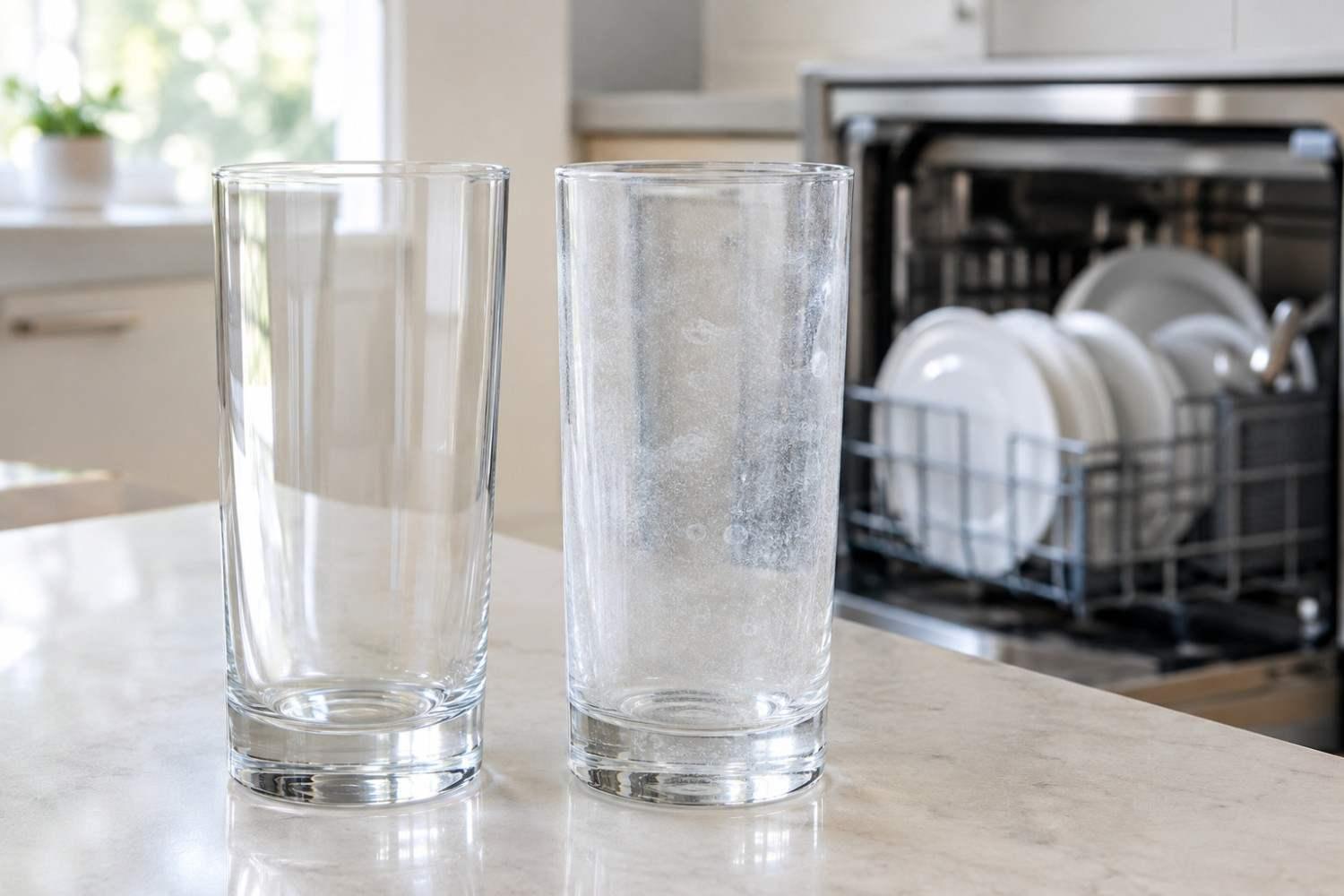
When a dishwasher still runs but leaves dishes dirty, the cause is usually something you can check without tools. The usual suspects are dishes blocking the spray arms, a clogged filter, detergent that isn’t dissolving, water that isn’t hot enough, or hard water working against the detergent.
A failed part is the last thing to suspect, because every other cause is cheaper to rule out. What you see on the dishes narrows the list quickly, so start there.
This guide works for any dishwasher, with a Murrieta layer. Our water is hard enough to change which checks matter. If you own a Miele, or a Bosch with a salt compartment, the softener section may be the most useful part of the page.
Start with what’s on your dishes
Take a dish that came out wrong, look at it in good light, and find the closest match below.
- Food bits or a gritty feel. This usually points to a clogged filter or spray arms that can’t reach the dishes. A gritty feel can also come from undissolved detergent or hard-water minerals. Start with checks 2, 3 and 4.
- Greasy film, or food that never softened. The detergent probably isn’t working at full strength. Think water that’s too cool, a dispenser that didn’t open, or a cycle too light for the load. Start with checks 1, 4 and 5.
- White, chalky film or spots. If it wipes or soaks off, it’s mineral film from hard water, which is common here. See how hard water affects appliances in Murrieta, then go to the water sections below.
- Cloudy glass that stays cloudy. If a vinegar wipe doesn’t clear it, that’s etching, which is permanent. See “Film or etching?” below.
- Spots and streaks on glasses, with no film. Skipping rinse aid can leave dishes streaky or cloudy. Check the rinse-aid dispenser first.
- One rack or one corner dirty. Something is stopping spray from reaching it, such as a tall pan jamming a spray arm, overloading, or a blocked arm. Go to check 2.
- Detergent left in the cup, or clumps on the dishes. Suspect damp or old detergent, a blocked dispenser door, or water too cool to dissolve it. See checks 1 and 4.
- Black or gray marks that look like pencil. These can come from aluminium rubbing against dishes loaded too close together. They are marks, not dirt.
- Standing water at the end of the cycle. That’s a drain problem. Clean the filter first, then see “When it’s the machine.”
- Everything dirty, with an unusually quiet wash. The circulation pump may not be moving enough water. It’s less common than everything above, so rule those out first, and listen for unusual noises.
- Everything dirty, with hammering during fill or very little water. That often points to the inlet valve or its screen. See “When it’s the machine.”
Five free checks, in order
We’ve ordered these by effort and cost, not by how often each happens. We don’t know of any reliable published figures on how often each dishwasher fault occurs.
Check 1: Watch the machine fill and check the water
- Make sure the supply valve under the sink is fully open.
- Run the hot tap nearest the dishwasher for at least 30 seconds before starting, as Whirlpool recommends.
- Pause a cycle a few minutes in and look for several inches of water in the tub. Open the door carefully, because there will be hot water and steam.
If you want a number, catch the hot water in a glass and use a kitchen thermometer. A typical water heater is set to 120°F, which is also what the Consumer Product Safety Commission recommends to reduce scald injuries.
A dishwasher with a heating element lifts the temperature itself, while one without relies on the supply. Your manual’s figure outranks any blog’s. One detergent maker puts the main wash at roughly 130 to 140°F, but that’s a commercial source.
Safety: Don’t raise your water heater’s thermostat to compensate. Hotter tap water is a scald risk, particularly for children and older adults. If the tap is still lukewarm after a minute, that’s a water-heater or plumbing problem to fix separately.
Check 2: Loading and spray arms
- Spin each spray arm by hand. It should turn freely, and tall pans and utensils often stop it.
- Load soiled surfaces toward the spray arms, space items out, and don’t stack or block them.
Then remove the arms and hold them up to a light. A clear arm lets light through nearly every hole, while a scaled arm shows many holes narrowed or blocked.
A toothpick clears individual holes. Avoid anything metal that could enlarge them.
Check 3: Clean the filter
The filter sits in the tub floor under the lower rack. Remove it as your manual describes, rinse it in warm water, and scrub gently with a soft brush.
A blocked filter lets food particles be redistributed onto dishes, which is why a gritty feel points here first.
Check 4: Detergent and dispenser
- Use dishwasher detergent only, because hand soap foams and overflows.
- Put a pod or tablet in the dispenser unless your manual says otherwise.
- Make sure nothing in the lower rack stops the dispenser door opening.
- If you use powder, start with about a tablespoon and keep it dry. Old or damp powder clumps and doesn’t dissolve.
Check 5: Rinse aid and cycle
Rinse aid helps water sheet off dishes, which reduces spotting. It does not soften the water. Keep the dispenser filled and its cap closed.
Pick a cycle that fits the load: a quick wash for lightly soiled dishes, and a heavy cycle for pots and baked-on food.
Then run one normal load and compare. If the same symptom returns, the next sections matter.
Advice that contradicts itself, and what to do
- Pre-rinsing. ENERGY STAR advises scraping dishes instead of rinsing them. Whirlpool adds that a very clean-looking load can make a soil sensor shorten the cycle. Scrape food off and skip the full rinse. If dishes will sit overnight, use the machine’s own rinse feature.
- Water temperature. You’ll see 120°F for the heater, 130 to 140°F for the wash, and “turn the heater up” on forums. The heater setting is a safety decision, and the wash temperature is the machine’s job. Measure what arrives, follow your manual, and leave the thermostat alone.
- Vinegar, citric acid or a branded cleaner. Whirlpool names vinegar with baking soda, or a branded cleaner, for its monthly clean. Bosch’s published warning against vinegar and citric acid is written for its washing machines, so don’t assume it covers a dishwasher. Use what your model’s manual names.
- Pods versus powder. Some guides say pods reduce film better, while forum users report the opposite in hard water. We found no independent test settling it. Pick one reputable detergent and change one thing at a time.
Is it your water?
Hard water contains calcium and magnesium. The minerals bind with detergent and weaken its cleaning power, leaving a chalky film on dishes and glass.
Hardness itself is not a health hazard, but it can make dishes look unclean even when the machine is working properly.
What the two Murrieta water agencies report
Murrieta homes are served by Western Water or Rancho Water (RCWD), and your bill says which. Both publish hardness in annual reports, and the numbers differ. To convert mg/L to grains per gallon, divide by 17.1.
- Western Water, local groundwater: the 2024 water quality report lists an average of 134 mg/L (about 7.8 grains), with a range of 14 to 457 (about 1 to 27 grains).
- Western Water, imported surface water: average 149 mg/L (about 8.7 grains), range 65 to 326 (about 4 to 19 grains).
- RCWD, imported water: 228 to 232 mg/L, averaging 230 (about 13.4 grains). RCWD says imported water is about two-thirds of its supply.
- RCWD, local well water: average 151 mg/L (about 8.8 grains), range 5 to 340 (under 1 to about 20 grains).
For a worked example, suppose your agency reports 149 mg/L. 149 ÷ 17.1 ≈ 8.7 grains per gallon. That’s the number to compare against your dishwasher manual in the next section.
On a common scale, water above 180 mg/L is “very hard.” RCWD’s imported water sits above that line, while Western’s averages sit below it.
Those ranges are the point. RCWD’s own 2025 report shows well water running from 5 to 340 mg/L, so the water at your tap depends on which source feeds your area. Treat these figures as bands, not your exact number. A hardness test strip from a hardware store will tell you what’s coming out of your own tap.
If you have a whole-house softener, it only helps while its resin is working. If you have one and still see film, have it checked.
Softeners also have trade-offs. RCWD notes that they typically use more water than they treat and can release salt by-products into wastewater. Our guide to RCWD hard water and your appliances compares the options.
If your dishwasher has a built-in softener, set it to your water
Not every dishwasher has one. If your manual mentions dishwasher salt or programming water hardness, yours does. Miele machines are built this way, and several Bosch manuals describe a salt-based softening system too. Not every Bosch model has one, so check yours.
Dishwasher salt doesn’t clean anything. It recharges the softener. A machine with an empty salt compartment or the wrong hardness setting can leave film no matter what else you do.
The threshold for softening varies by manual:
- One Miele manual says water above about 8 grains per gallon (140 ppm) should be softened.
- A newer Miele manual says water above about 4 °dH needs softening.
- A Bosch manual puts the line at 7 °dH, roughly 125 mg/L.
On those thresholds, nearly every average figure above calls for softening. The one exception is Western’s groundwater average of 134, which sits just under the oldest Miele line but above the others.
Program the machine to your water. Miele’s manuals say that where hardness fluctuates, you should set the higher value. Don’t trust the factory setting, either. The older Miele manual lists a default of 4 grains (70 ppm), while a newer one ships at 20.
A machine left at 4 under-softens RCWD’s imported water, and one left at 20 is set higher than the water needs. One Bosch manual notes that a hardness test strip comes in the use-and-care kit for exactly this purpose.
Combination tablets add a wrinkle, and manuals disagree. One Miele manual says to add salt even with tablets that contain it. Another says salt isn’t required with combination detergents below about 21 °dH, roughly 375 mg/L.
Murrieta’s reported averages are all below that ceiling, so for some models salt may be optional with combination tablets. Check your own manual.
If you have a working whole-house softener, one manual says to leave salt out when your supply is constantly below its threshold, but still to program the hardness. Our Miele dishwasher maintenance guide covers salt, descaling and filter care in more depth.
Clearing scale and mineral film
Once the settings are right, clear what has already built up. Whirlpool suggests cleaning the interior every 30 days. For Murrieta homes, we recommend an empty cycle with a dishwasher descaler at least every three months, and sooner if film keeps returning.
Regular descaling is one of the simplest habits for extending the life of your appliances.
Hold the spray arms to the light again afterwards. Cleaning should reopen the holes. For heavily scaled arms, we use a citric acid soak of about 30 minutes.
Never mix cleaning products. Mixing bleach with vinegar or any acid releases chlorine gas. If you’ve used a bleach-based product in the tub, rinse thoroughly before using anything acidic.
Film or etching?
Cloudy glassware has two causes, and only one can be reversed. Mineral film can be dissolved, but etching is permanent damage to the glass surface.
To tell them apart, wipe or soak one cloudy glass in white vinegar, then rinse it. If the cloudiness clears, it was mineral film. If it doesn’t, it’s etching, and nothing will remove it.
Etching is linked to soft water, too much detergent, or very hot water. In Murrieta we’d expect film more often than etching, but that’s our inference. If you’ve added a whole-house softener or set a built-in one too high, etching becomes more plausible. Stick to your manual’s detergent amount.
When it’s the machine
If every check passes and the symptom persists, a part is likely. These are the prices we publish for Murrieta, each confirmed as a flat-rate quote after diagnosis.
- Scale in the spray-arm holes: a scale cleaning from $95, with the diagnostic fee waived. Replacing the spray-arm assembly costs $180 to $350 and doesn’t solve the water problem behind the scale.
- Failed heating element (on machines that have one): $150 to $280.
- Failed drain pump: $180 to $280.
- Failed control board: $250 to $500.
- Wash pump and inlet valve: quoted after diagnosis.
For overall range, standard brands typically run $180 to $450, Bosch and other premium brands $250 to $650, and Miele $350 to $850.
On a Bosch, an E15 code is a different fault. See our Bosch E15 error guide.
For cleaning problems alone, you can generally keep using the machine and rewash anything with food on it. Stop and call us if you see leaking, standing water that never drains, grinding, a burning smell or a tripped breaker. It also helps to know the hidden costs of DIY appliance repair before opening anything up.
Repair or replace?
Brand and repair cost matter more than age alone. Our guidance:
- Standard dishwasher, about 8 years old, failed pump (about $350 repair): usually worth fixing, because a new one costs $500 to $1,200.
- Standard brand, about 12 years old, several parts failing: leans toward replacement.
- Standard brand over 10 years old facing a $400-plus repair: often favours replacement.
- Bosch, about 10 years old, $300 to $400 repair: usually makes sense to fix.
- Miele under about 15 years old: almost always worth repairing.
As a worked example, a $350 repair against a $500 to $1,200 new machine is 29% to 70% of the replacement price. The wider the gap, the stronger the case for repair. That range excludes delivery and installation, which vary.
A new machine will also face the same water, so settings, salt and descaling matter just as much after a replacement. For a broader framework, see our guide to whether an old appliance is worth repairing.
If the checks haven’t fixed it
A diagnostic visit exists for this situation. We check the spray arms and scale on every dishwasher call before recommending parts.
- Cost: $89, waived if you go ahead with the repair.
- Quote: a flat-rate quote before work starts.
- Warranty: 90 days on parts and labour.
- Availability: Monday to Saturday, 8 am to 5 pm. Same-day service is available for calls before 11 am.
- Coverage: Murrieta, French Valley and Winchester, plus Temecula for premium-brand calls.
We service Bosch, Miele and most other major brands. To book dishwasher repair in Murrieta, call (951) 592-3670 or text us during business hours.
How we checked this
Hardness figures come from the most recent agency reports we found: Western Water’s 2024 report and RCWD’s 2025 report. Scrape-don’t-rinse guidance comes from ENERGY STAR and Whirlpool, and the hot-water safety guidance from the Consumer Product Safety Commission.
Built-in softener details come from Miele and Bosch owner’s manuals for several models, which vary. Your own manual overrides this page. Repair prices are the ranges published on our dishwasher repair page.