Water leaves a dishwasher along a fixed route: filter, pump, drain hose, then the sink plumbing. If something blocks that route anywhere, the water stays in the tub, and Whirlpool’s own guidance says most drain problems trace back to restricted flow somewhere along it.
So before you suspect the pump, check three places in this order: the filter and sump, the sink side (disposal and air gap), and the drain hose. They run from least effort to most, and Checks 1 and 3 need only basic tools.
If the water is still there after all three, stop. What remains is parts and electronics, and the later sections explain how to recognise that point and what it costs in Murrieta.
In a hurry?
- Switch the dishwasher off at the breaker and bail out the water.
- Check 1: clean the filter and look in the sump.
- Check 2: run the disposal, clear the air gap, and after recent disposal work confirm the knockout plug was removed.
- Check 3: look for a kinked or clogged drain hose.
- Humming, grinding, silence, a tripped breaker or leaks mean stop. See “When to stop” below.
Before you touch anything
Have ready: a bucket, towels, a flashlight, a soft brush, gloves, and a screwdriver or pliers for the hose clamp.
- Switch off the dishwasher at the circuit breaker, not just the control panel. Confirm the display and lights are off.
- Wear gloves. The water can be hot, and some debris in the filter area can be sharp.
- Bail out the standing water with a cup, sponge or turkey baster, and lay towels in front of the machine.
- Keep chemicals out of the machine. GE and Whirlpool both advise against drain cleaner in the dishwasher. We’d also skip vinegar and baking soda as a drain fix. Neither guide lists it, and a blockage has to be physically removed, not dissolved.
- Never reach into a garbage disposal to check it. GE warns it can cause serious injury.
Don’t start another full cycle on top of standing water. The tub is already holding water it can’t clear, and a fresh fill can overflow onto your floor. Treat anything that sat in that water as unwashed and rewash it.
Is the water in the bottom normal?
It depends on the model, so your manual has the final word. Use depth and clarity as a guide:
- A little clean water in the sump or filter area: often normal. GE says some models without an ultra-fine filter keep a cup or two of clean water on the tub floor, while models with one keep a little in the sump but shouldn’t show water across the floor.
- Water just above the filter screen: Whirlpool reads this as a partial restriction in the filter, sump or hose.
- Murky water spread across the floor: in our reading, the drain phase isn’t completing.
- Water up near the door opening: Whirlpool points to a severe blockage or a pump that isn’t running.
Also confirm the cycle actually finished. If the door was opened mid-cycle or the power blinked, the machine may never have reached its drain phase. Many models have a cancel or drain function, but the buttons and hold time vary by brand, so check your manual.
How the water gets out, and where it gets stuck
Tub floor → filter → sump → drain pump → drain hose → air gap or high loop → disposal or sink tailpiece → house drain
Terms you’ll meet below:
- Sump: the low well in the tub floor where the filter sits and the pump draws from.
- Air gap: a small fitting, often a chrome cap on the sink deck near the faucet, that breaks the direct connection between the dishwasher drain and the sink plumbing so sink water can’t flow back.
- High loop: the alternative where no air gap is fitted. The drain hose is raised and fastened to the underside of the counter before dropping to the drain, for the same anti-backflow purpose.
- Check valve: a one-way valve near the pump that stops drained water falling back into the tub.
Read your symptom first
- Standing water after the cycle, nothing else unusual: work through Checks 1, 2 and 3 in order.
- Draining slower over weeks, or water sitting just above the filter: start with Check 1. It fits a partial restriction.
- Started right after a disposal was replaced or the dishwasher was installed: Check 2 (the knockout plug), then Check 3. A blocked inlet stops drainage outright.
- Started after the machine was moved or pushed back: Check 3. A pinched hose is the likely suspect.
- Sink is slow or gurgling, or water backs up into the sink when the dishwasher runs: Check 2. They share a drain.
- Water spills out of the air gap cap while draining: Check 2. The blockage is downstream of the air gap.
- Water drains, then returns: Check 3 first, since without a high loop or a working air gap, wastewater can flow back into the machine. If routing is correct, stop.
- Suds or foam in the tub: a detergent problem. GE lists too much, or the wrong, detergent as a drain-stopper. Use only dishwasher detergent, in the amount your manual states.
- Hums but nothing moves, or grinds: Check 1 for debris, then stop. Whirlpool links humming to a jammed impeller and grinding to hard debris such as glass.
- Silence when it should be draining: stop. Whirlpool points to an electrical or control cause.
- An error code: read your manual, because meanings differ by brand. A Bosch E15, for example, is a base-pan leak fault, not a drain fault.
This shows where problems usually sit. It is not a diagnosis. If the machine is also making unusual noises, note when they happen.
Check 1: The filter and sump
This is the most accessible blockage and the least effort. Bosch’s US guide calls a clogged filter or pump the most common reason a dishwasher stops draining.
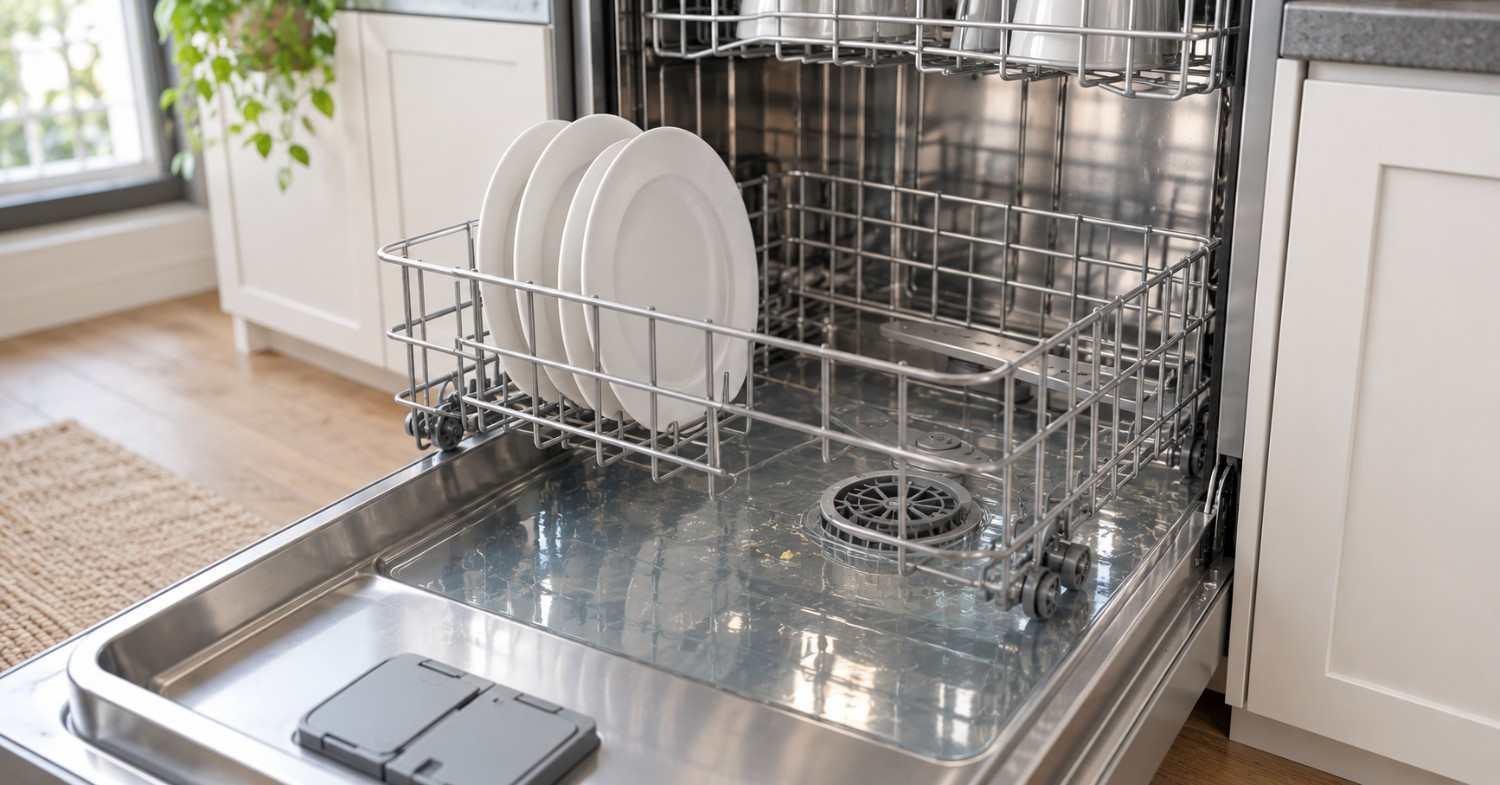
- With power off, remove the lower rack.
- Take out the filter as your manual describes. Many twist and lift out, and some have a coarse and a fine part.
- Rinse it under warm water and clean it with a soft brush. Use nothing abrasive.
- With a flashlight, look into the sump for labels, seeds, toothpicks, bones, or glass.
- Refit the filter fully seated. A loose filter lets debris reach the pump.
- Test it (see “After each check” below).
What you’re looking for: food is common, but glass matters most. If you find glass, there may be more further in, and grinding or humming on the next drain suggests it reached the pump.
Some models have a pump cover under the filter. Bosch’s US guide shows removing it, as your owner’s manual describes, to look for debris and sponge out water. If your manual shows this and you’re comfortable, keep the power off and gloves on. If the cover won’t release easily, don’t force it.
Miele owners can find filter and spray-arm care in our Miele maintenance guide. If the dishwasher drains but the dishes come out dirty, see our dishwasher not cleaning guide.
Check 2: The sink side
A dishwasher drains through the same plumbing as the kitchen sink, usually via the disposal or the sink tailpiece. If that path is blocked, even a healthy dishwasher can’t empty.
- Test the sink. Run water. If the sink is also slow, the clog is in the house plumbing, and clearing the trap or tailpiece may solve it. If you’re not comfortable doing that, it’s a plumber’s job, not a dishwasher repair.
- Run the disposal to clear food from the dishwasher inlet. GE advises running it before every dishwasher cycle. Keep your hands out.
- Clean the air gap if you have one. Twist off the cap and clear any debris. If water spills from it while the dishwasher drains, the blockage is downstream.
- After recent disposal work, confirm the knockout plug was removed. Every new disposal has a plug in its dishwasher inlet, and InSinkErator says it must be removed to connect the dishwasher drain hose. If the dishwasher stopped draining right after a disposal was installed or replaced, ask about this first. Removing the plug means disconnecting the hose and working on the disposal, so follow the disposal’s installation guide or contact whoever installed it.
California note: the air gap
California’s plumbing code (§807.3, which follows the Uniform Plumbing Code) says a dishwasher shouldn’t connect directly to a drain or disposer without an approved air gap fitting, installed with its flood-level mark at or above the sink’s flood level. So you may well have that chrome cap on your sink, and if you do, it’s one of the places debris collects.
Not every home has one. Older, remodelled or unpermitted work may use a looped hose instead. Whether your setup meets the code in force is a question for a licensed plumber or your building department, not something to tear out to fix a drain.
If the disposal itself hums but won’t turn, see our garbage disposal repair page.
Check 3: The drain hose
The hose runs from the pump at the bottom of the dishwasher to the disposal, tailpiece or air gap. The accessible end is under the sink.
- Look for kinks, crushing or sagging, especially if the machine was recently moved. Check that nothing stored under the sink is pressing on the hose.
- Check the routing. With no air gap, GE says the hose needs a high loop fastened to the underside of the counter, at a height set in your installation instructions. Don’t guess a number.
- Check for a clog. Put a bucket and towels under the connection and loosen the clamp. There may be hot water in the hose. Look into the hose end and the disposal or tailpiece inlet, and flush the hose with warm water. For stubborn debris use a flexible plastic line or a brush made for the job, never anything sharp.
- Reconnect with the clamp snug, not overtight, and keep the loop.
Stop here if you’d have to pull the machine out. The rest of the hose runs behind and under the dishwasher, and reaching it means disconnecting power, water and drain from a built-in unit. That’s where a DIY check turns into a service call.
After each check, test it
Run a short rinse or your model’s drain function. Listen for the pump and watch the water at the end. While it runs, watch under the sink for leaks and at the air gap for spilling water. If it drains fully, you’re done. If not, move to the next check.
When to stop, and what’s probably next
Stop and get it looked at if:
- The pump hums with no flow, or grinds, after Check 1.
- You hear no pump at all when it should drain.
- The breaker trips, you smell burning, you see damaged wiring, or you see a leak. Whirlpool says to stop for these.
- Water returns after draining even though the hose and air gap are right.
- Reaching the cause means pulling the machine out or removing panels, especially if it’s hard-wired.
- An error code returns after the checks.
- It’s a portable dishwasher on a unicouple connection. GE says those need service.
- You rent. Tell your landlord before opening panels or touching plumbing.
Past this point the usual suspects are inside the machine:
- Drain pump and impeller: a motor-driven impeller pushes water out. It can jam with debris, or the motor can fail.
- Check valve: a valve that sticks shut can block drainage, and one that doesn’t seal can let water creep back.
- Drain solenoid: on some older designs, it opens the drain path.
- Door switch, wiring or control board: if the pump never gets power, the cause is electrical.
Plumber or appliance technician? If the sink is also slow, or water spills from the air gap, the problem is probably the house drain, and a plumber is the right call. If the sink drains normally and the dishwasher hums, grinds or stays silent, you likely need an appliance technician.
Before opening anything further, read about the hidden costs of DIY appliance repair.
What a repair costs in Murrieta
These are our published ranges. We confirm a flat-rate quote after diagnosis and before work starts.
- Diagnostic visit: $89, waived if you go ahead with the repair.
- Drain pump replacement: $180–$280.
- Control board replacement: $250–$500.
- Standard brands, overall: $180–$450.
- Bosch and other premium brands, overall: $250–$650.
- Miele, overall: $350–$850.
A diagnostic takes 20 to 40 minutes, most standard dishwasher repairs finish in the same visit, and repairs carry a 90-day parts and labour warranty. Bosch parts typically arrive in 24 to 72 hours and Miele parts in 3 to 7 days, so Miele repairs often need a return visit.
Repair or replace? Compare the repair with a new machine. We list new dishwashers at $500–$1,200, excluding delivery and installation. A $180–$280 pump is about 15% to 56% of that, taking the lowest and highest ends of each range. As one example, a $280 pump on a machine you’d replace with an $850 model is about 33%.
Our guidance by age and brand:
- A standard dishwasher about 8 years old with a failed pump is usually worth repairing.
- A standard brand around 12 years old with several parts failing leans toward replacement.
- A Bosch around 10 years old with a $300–$400 repair usually makes sense to fix.
- A Miele under about 15 years old is almost always worth repairing.
These are guides, not quotes. For more, see whether an old appliance is worth repairing and our premium appliance repair versus replace guide.
How to stop it happening again
- Scrape plates into the trash instead of heavy pre-rinsing.
- Clean the filter on your manual’s schedule, and more often if you wash heavily.
- Run the disposal before you start the dishwasher. See what never to put in a disposal.
- Use only dishwasher detergent, in the amount your manual states.
- If you have an air gap, remove the cap and clear it now and then.
- After any under-sink work, check the hose isn’t kinked and the loop or air gap is intact.
If it still won’t drain
If the three checks haven’t cleared it, or you hit a stop sign above, we can take it from there. Our dishwasher repair service covers Bosch, Miele, KitchenAid, Samsung and other brands.
When you call, it helps to tell us:
- The brand, model and any error code.
- What you saw: water depth, and whether the pump hums, grinds or stays silent.
- Which checks you did and what you found.
- Any recent disposal work, remodel, or moving of the machine.
Our terms:
- Diagnostic: $89, waived if you go ahead with the repair.
- Quote: flat-rate, before work begins.
- Warranty: 90 days on parts and labour.
- Availability: Monday to Saturday, 8 am to 5 pm, with same-day service for calls before 11 am.
- Area: Murrieta, French Valley and Winchester, plus Temecula for premium-brand calls.
How we checked this
Safety, filter, sump, hose and air gap steps come from Whirlpool, GE Appliances and Bosch’s US owner-support guide. The knockout plug point comes from InSinkErator’s support page. The air gap note comes from California Plumbing Code §807.3, so check the edition in force in your area.
Repair prices are our own published ranges. We don’t quote how often each fault occurs, because we found no reliable independent data. Your owner’s manual overrides this page, and the order of the three checks reflects effort and cost, not frequency.