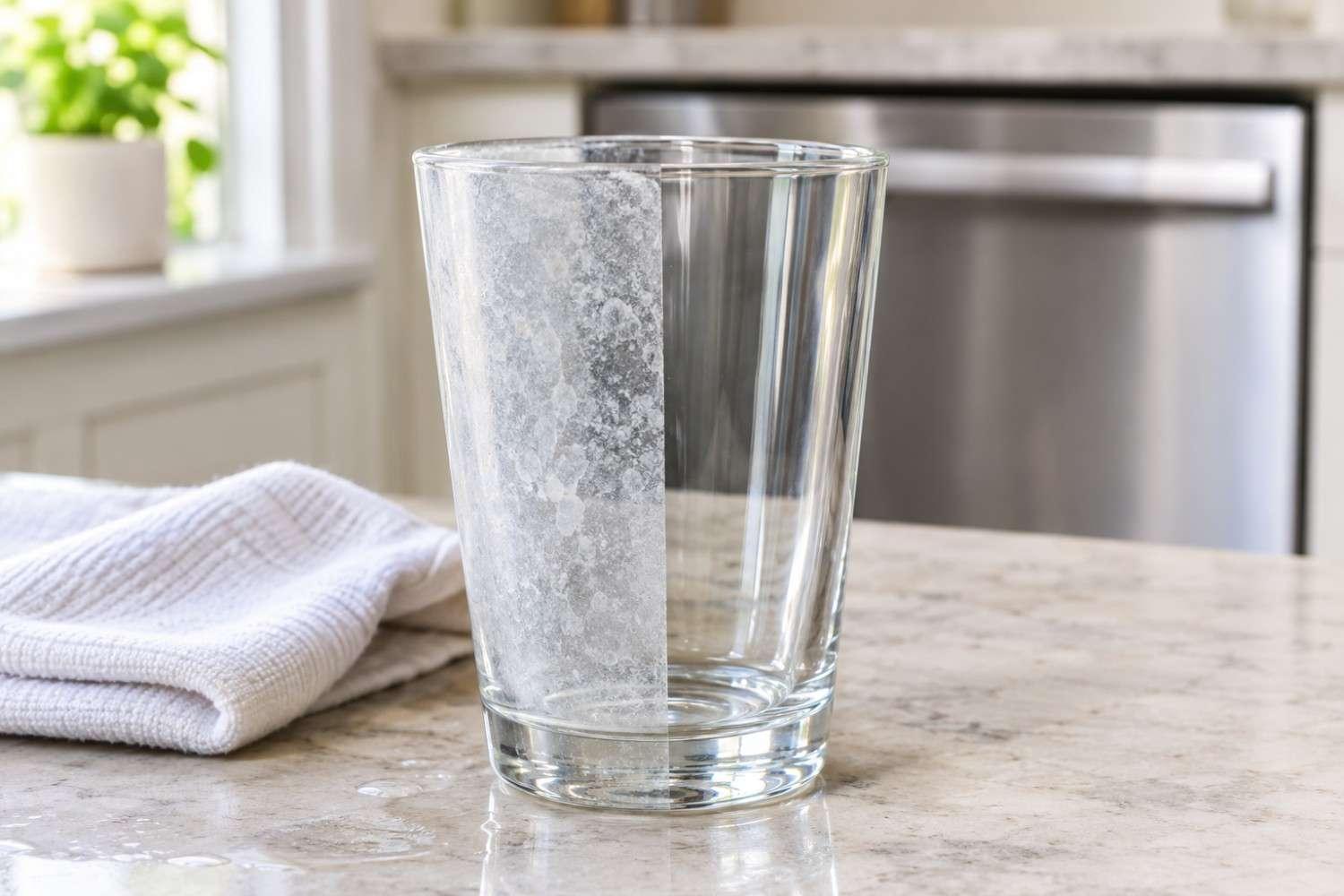
In Murrieta, white film on dishes is most often hard-water minerals drying onto them. It can also be leftover detergent, too much rinse aid, or etching, which is permanent damage to the glass. Each needs a different fix, and some common fixes make the wrong one worse.
This page helps you work out which one you have. If your dishes are dirty rather than filmy, start with our guide to dishes coming out dirty.
Start with a one-minute test
- Pick a cloudy glass. Note whether the film is also on the tub and the plastics.
- Hold a cloth soaked in undiluted white vinegar on the cloudy area for a few minutes, then wipe it dry.
- Compare it with an untouched part of the glass.
What you see tells you where to go:
- The film clears or lightens. It’s mineral deposit. Go to the fix order below.
- The film stays. It’s etching or silica film. Cleaning won’t remove it, and the aim is to stop it getting worse.
- It rinses off with plain water, or feels powdery or slippery. It’s detergent or rinse-aid residue, not minerals.
Five kinds of white film
Manufacturers separate these because the fixes differ. Whirlpool’s guidance on filming and etching covers the film-versus-etching split.
- Mineral film: a chalky or cloudy haze on glasses, the tub and the heating element. It’s the hard-water form.
- Etching: dull or rough cloudy glass that doesn’t wipe off. Whirlpool lists water that’s too soft among its causes.
- Silica film: a milky, rainbow-tinted deposit that also resists vinegar. Some manufacturer pages describe it.
- Undissolved detergent: gritty or powdery residue, often from cold inlet water, damp detergent or blocked spray.
- Too much detergent or rinse aid: a slippery, soapy film. Sub-Zero and Wolf’s support page names both.
Stainless tubs make any film more visible, so a filmy tub doesn’t always mean worse water.
What Murrieta’s water actually delivers
Murrieta doesn’t have one water supply. Depending on your street you may be served by Western Water, Rancho Water (RCWD) or Eastern Municipal Water District (EMWD). Your bill shows which.
French Valley and Winchester, which we also serve, are listed among EMWD’s communities. Each district blends imported water with local groundwater, so hardness varies by source and season. Our hard water and home appliances guide covers the wider picture.
- Western Water, Murrieta service area (2025): its report lists groundwater averaging 166 mg/L (about 9.7 grains per gallon) and surface water averaging 150 mg/L (about 8.8).
- Rancho Water (2024): its report shows imported water near 242 mg/L (about 14 gpg) and local groundwater averaging 150 mg/L.
- EMWD (2023): its report lists hardness averages by source from about 5 to 20 gpg.
To convert, divide mg/L by 17.1. For example, 166 ÷ 17.1 ≈ 9.7 gpg.
Two cautions:
- Averages hide the spread. Western’s Murrieta groundwater alone ranges from 50 to 300 mg/L, and Rancho Water’s local groundwater runs from about 5 to 340. Hardness strips give your tap’s actual number.
- “Hard” depends on the scale. The USGS scale calls 121–180 mg/L hard, with very hard above that. On it, Western’s averages are hard, while Rancho’s imported water and the hardest EMWD sources are very hard. EMWD’s own scale calls 8.8–17.5 gpg hard. Look at the number, not the label.
Rancho Water customers can also read our RCWD hard water guide.
Why harder water means more film
As water evaporates off dishes, the tub and the heating element, the calcium and magnesium stay behind. Rinse aid helps water sheet off instead of beading. More detergent doesn’t cure film, because detergent that can’t rinse away becomes its own film.
Fix it in this order
- Check the detergent. Use one reputable pack or tablet, measure the dose and keep it dry. GE notes that phosphate-free detergents can leave film, most often in hard-water areas.
- Set the rinse aid. Raise the dial one step if you see spotting. Lower it one step if the film is slippery.
- Clear the filter and spray arms. Hold the arms to a light and look for scale in the holes.
- Check the hot water. Run the tap hot first, and follow your manual for inlet temperature.
- Descale. GE’s method is citric acid in the detergent cup, filmed glassware loaded (no silverware or metal), and a full cycle without detergent. Or use the cleaner your manual names. Never combine bleach products with acids.
- Re-test with a few glasses. If they come out clear, stop.
If film returns within weeks, the water is probably too hard for these steps alone.
Check whether your dishwasher softens its own water
Some dishwashers have a built-in softener fed by dishwasher salt. The reservoir is usually a screw cap on the tub floor, and your manual will mention “salt” or “water hardness” if you have one.
- Bosch: only some US models have it. One US retailer lists the Benchmark and ADA-height 800, but sites disagree, so check your manual rather than the series name.
- Miele: the manuals I checked describe a softener, salt and a programmed hardness value.
- GE, Whirlpool, KitchenAid, Samsung: their film guidance points to detergent, rinse aid and cleaning cycles.
If yours has one:
- Use dishwasher salt, not table salt.
- Set the hardness to your supplier’s figure. European machines may ask for °dH or mmol/L. Western’s 166 mg/L is about 9.3 °dH, or 1.7 mmol/L. Where hardness fluctuates, Miele’s manuals advise the higher value.
- Don’t trust the factory default. One Miele manual lists about 1 °dH and another 15 °dH.
- Know your model’s threshold. One Miele manual says water above about 8 gpg (140 ppm) should be softened. Western’s 2025 averages of 8.8 and 9.7 gpg are above that.
Our Miele dishwasher maintenance guide covers salt and descaling in more depth.
Already have a whole-house softener? Watch for etching
Very soft water plus a full detergent dose can attack the glass. If you have a softener:
- Use less detergent.
- Scrape plates rather than rinsing them.
- Use shorter or cooler cycles for glassware.
- Check the softener actually has salt and is regenerating.
- Ask your installer whether the setting needs to be near zero.
Etching can’t be reversed. Hand-wash any glass you care about.
Do you need a whole-house softener?
Not for film alone. Work the fix order first.
Whirlpool says deposits at 15 gpg or more can damage dishwashers and recommends a softener. In our data, Rancho’s imported water (about 14 gpg) and the hardest EMWD sources (about 20) are near or above that. Western’s averages are lower.
This is a plumbing and water-treatment decision rather than an appliance-repair one. Rancho Water’s FAQ cautions that softeners use water to flush and add salt by-products to wastewater and groundwater, so ask your district. Scale can also shorten the life of other appliances, as our climate and appliance lifespan guide explains.
When it’s the machine, not the water
Look at the machine if:
- Film returns right after a descale with the right detergent and rinse aid.
- Dishes aren’t drying.
- The rinse-aid level never seems to drop.
- Water stands in the tub. Our dishwasher not draining guide covers that.
On our dishwasher repair page, a scale cleaning is $95 with the diagnostic waived, against $180 to $350 to replace a spray-arm assembly.
Need a technician?
The diagnostic is $89, waived if you proceed with the repair, and we check spray arms and scale on every dishwasher call. We’re open Monday to Saturday, 8 am to 5 pm, with same-day visits possible for calls before 11 am.
We cover Murrieta, French Valley and Winchester, from Greer Ranch to Copper Canyon.